


3 months ago we launched a new report series where we take every VC fund that announced a first or final close, break the list apart by sector, geography, stage and manager type, and share our perspective about what it actually means for emerging fund managers and allocators.
After State of VC Fundraising Q2 2026 the question we kept hearing was whether the “concentration inside a contraction” we described was just a one-quarter anomaly. Q3 answers it pretty clearly. It seems it wasn’t.
This is the 2nd edition, same method: every VC fund that publicly announced a first, interim or final close between July 1 and September 30, 2026.
For context, in October the PitchBook-NVCA Venture Monitor reported $108.5B raised across 699 US funds year-to-date, already 38.6% above all of 2025. Seems fundraising activity is rebounding back to the 2022 numbers, but we already taught to look at the shape and not just a size.
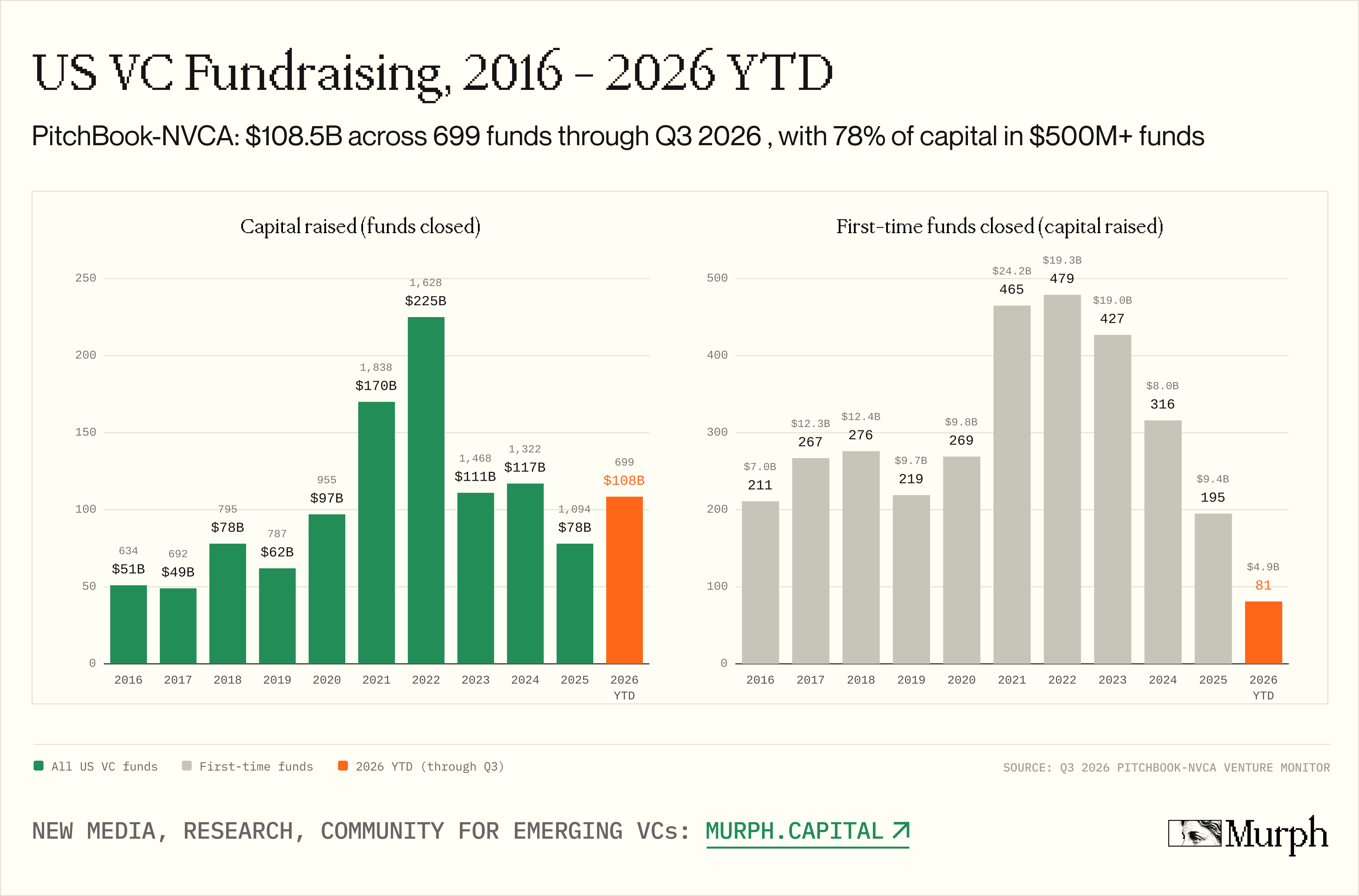
Funds of $500M or more took 78.1% of all capital raised YTD while making up just 6% of funds closed.
Only 81 first-time funds have closed in 2026, raising $4.9B, on pace for the lowest count in a decade.
Funds between $100M and $500M were roughly 17% of all closes before 2021. Through Q3 2026 they are 10%, the lowest on record.
These broad market figures from PitchBook give us the macro view, but to understand what’s actually happening underneath, we looked at our own data – tracking funds publicly announced across our media platform.
In Partnership With

Legion is a high-signal marketplace matching emerging GPs with relevant LPs, featuring seamless fund admin, built-in secondary liquidity, and over $300M in investor capital flows.

Harmonic aggregates real-time data on 30M+ companies and 190M+ people to surface the signals that actually matter – all through AI-powered workflow.
Rings AI is an intelligent CRM built for VCs and LPs with auto-enriched data on 100M+ contacts, and a visual map of who-knows-who across your network.
Cura is a VC portfolio intelligence on autopilot that connects your Granola notes, iMessage, LinkedIn data and more to automate support and intelligence.
Wonderstruck is the storytelling and design studio venture-backed companies call when they outgrow their brand. Trusted by 1517, Kindred, Sunflower & 200+ founders.
Summary Statistics
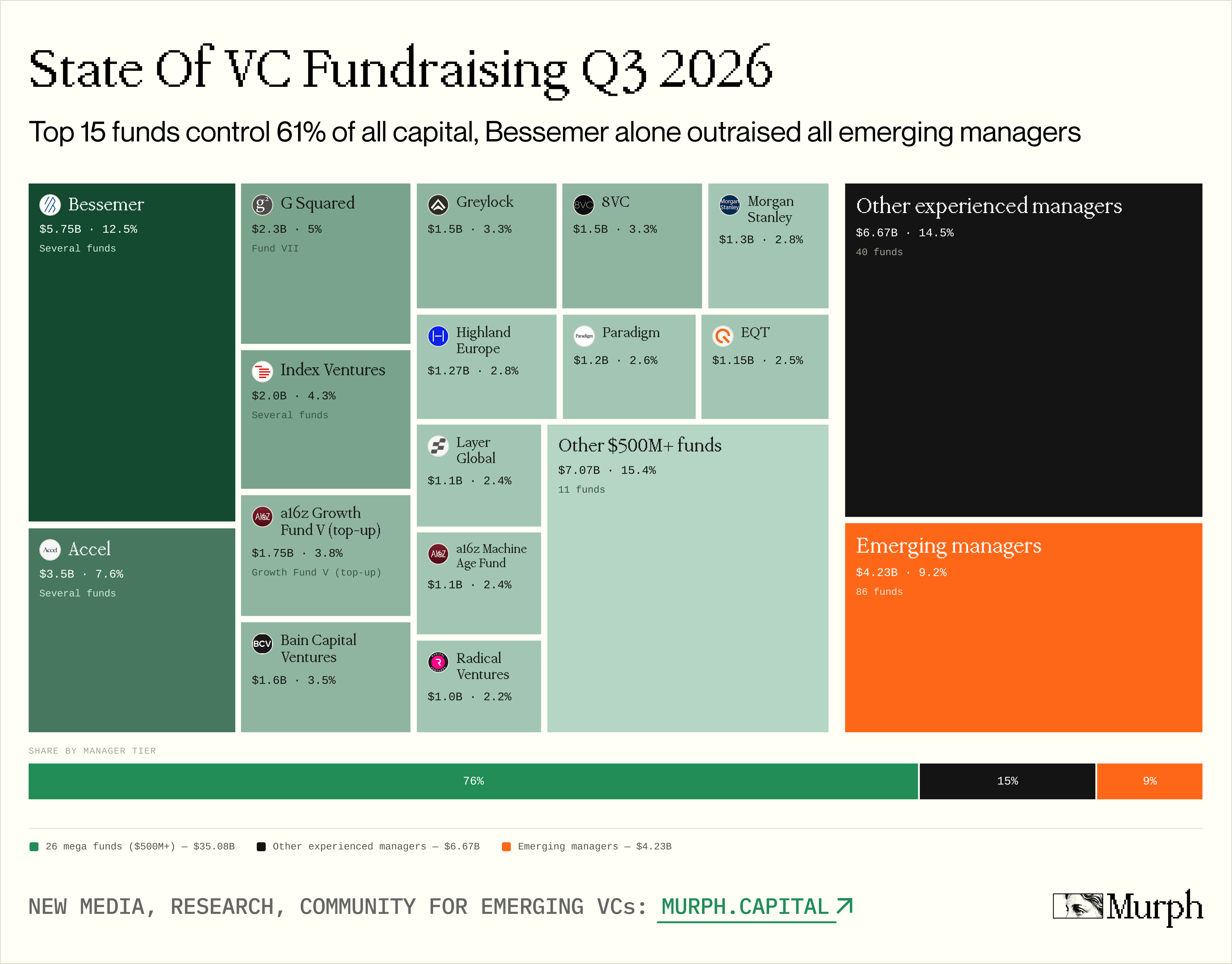
We tracked 152 funds that announced a close in Q3 2026, up from 137 in Q2, with $46B of disclosed capital against $39.3B last quarter. We saw few surprises compared to the previous quarter, the “concentration inside a contraction” preserves just more pronounced: 26 funds of $500M or more absorbed 76% of all Q3 capital, and Bessemer’s $5.75B close alone outraised all 86 emerging funds combined. Here are a few key insights if you don’t have time to read the full report:
Emerging funds. 86 debut-or-sophomore funds under $250M raised $4.23B – 9% of the quarter’s capital on 57% of the count, down from 13% in Q2. Their sector mix mirrors the market in reverse: Climate is their biggest thematic category (18% of emerging dollars, against 2% of the whole market), Defense takes 10% (against 3%), and operator-turned-GPs dominate the cohort.
Mega funds. 26 funds cleared $500M, up from 15 in Q2, raising $35.1B between them. 3 drivers explain almost all of them: AI position marks (Bessemer, Accel, Greylock), realized exits (Index’s Wiz payout, Highland Europe’s distributions, Blackbird’s Eucalyptus) and the shift to growth and secondaries products (G Squared, Morgan Stanley, Layer Global, Radical). Again, a quarter of funds monetizing specific wins.
Verticals breakdown. Generalist/Multi-stage platforms took 61% of all capital, up from 55% in Q2. Among thematic funds, AI/ML & Infra ($3.8B) and Enterprise/B2B SaaS ($3.4B) lead by dollars, Deep Tech leads by count (22 funds), and Climate is the largest vertical where emerging managers outraised both other tiers.
Geographic breakdown. The US and Europe combined for 63% of funds and 87% of capital, but Europe raised just 18% of the US total (a 5.7x gap, up from 4x in Q2). The surprise of the quarter is Canada: 9 funds, $2.38B and 3 mega funds, all announced around the Canada Investment Summit.
Capital concentration. A median close of $71M against a $319M mean, a 4.5x spread (3.7x in Q2). By count the tiers split 57% Emerging, 26% Middle, 17% Mega. By dollars: 9% / 15% / 76%. Both ends lost share to the top.
LP analysis. 83 of 152 funds named at least one LP: 375 LP-fund mentions across 351 unique names, and only 16 LPs backed more than one fund. Development finance institutions are again the most common LP type, followed closely by pensions, endowments and foundations. Only 8 of the 26 mega funds named a single LP.
Emerging Funds
86 funds met our “emerging” bar this quarter: a debut or sophomore fund (Fund I or II) under $250M, the same definition as Q2.
The largest of them, Molten Ventures’ $235M Growth Fund I, is bigger than 22 of the 40 funds in our Middle bucket, while the median emerging close fell to $31M from $55M in Q2.
Worth mentioning that we count only capital newly closed in Q3: where a fund had announced an earlier close before July, we subtract it, which shrinks 12 of these funds (SparkEdge, Expeditions, Protego, Activate and Clean Growth Fund among them) well below their headline final-close figures. Below, we split them into 3 size bands and pulled out the ones with the sharpest theses or the most unusual backstories:
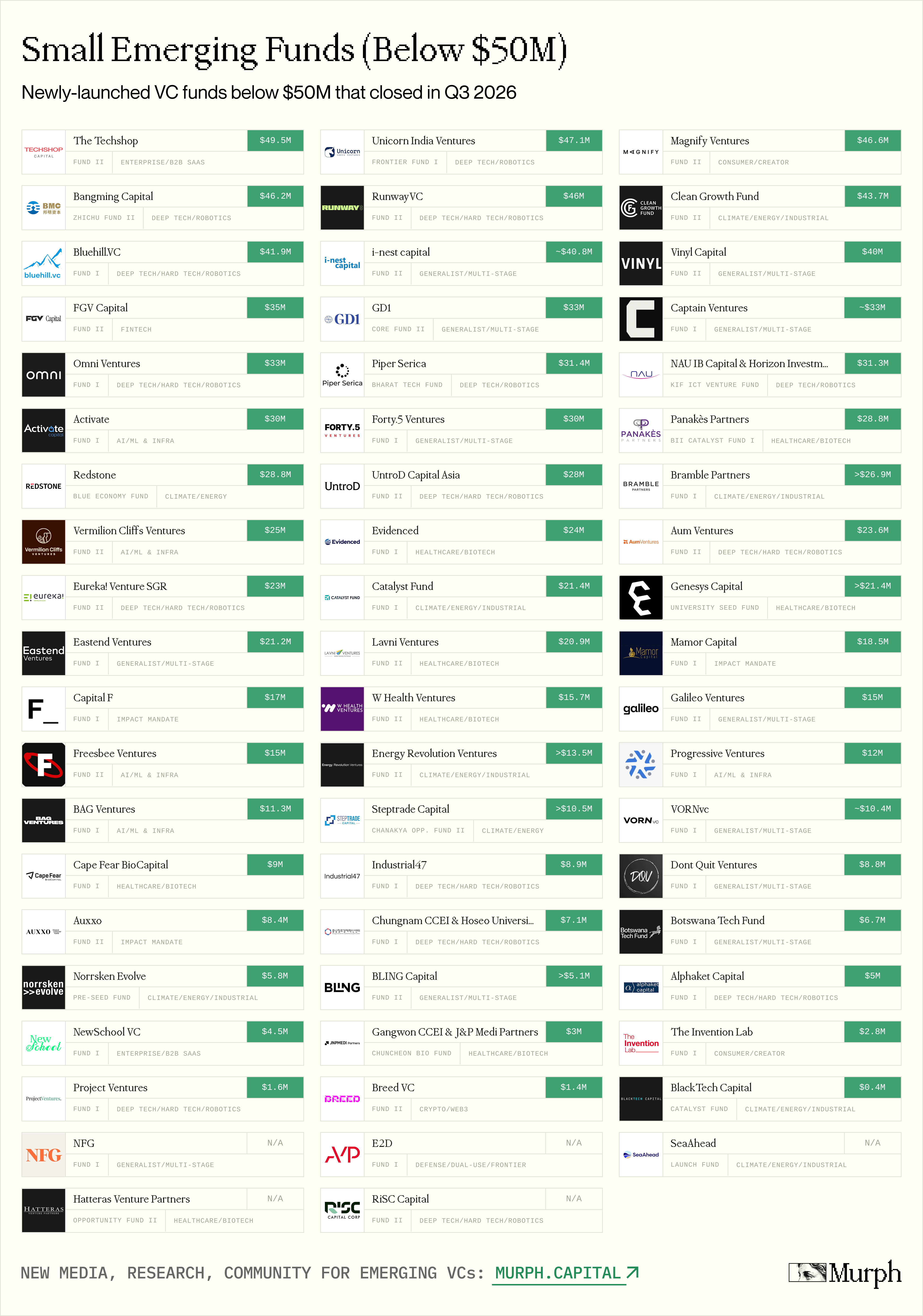
Small funds (under $50M): 59 funds, including 5 that closed without disclosing a size
Mid-size funds ($50M–$150M): 21 funds
Large funds ($150M+): 6 funds
Small Emerging Funds
Omni Ventures ($33M, Fund I). 2 former Apple manufacturing engineers, Sabrina Paseman and Simon Lancaster, writing $700K-$1M pre-seed checks into shop-floor software, industrial AI and robotics. The pitch is a network of 32,000+ industry contacts rather than a brand. Oversubscribed, anchored by the fund-of-funds Allocator One, with LPs in 14 countries.
Breed VC ($1.4M in Q3, Fund II). Jed Breed, formerly head of digital assets at Circle, kept his solo-GP fund deliberately small: $250K-$750K checks into day-zero founders in open financial infrastructure and decentralized AI. The fund is $15M, but $13.6M of it was announced at first close last November. LPs include FalconX and Arrington Capital. In a quarter where crypto fundraising was 99% Paradigm, this was the other crypto fund.
GD1 ($33M, Core Fund II). New Zealand’s Global From Day 1 held a NZ$56.7M first close of a NZ$150M target, and about 20% of it came through New Zealand’s Active Investor Plus “golden visa” programme. Unusual funding channel that we haven’t seen anywhere else in the dataset. The rest came from returning LPs and from executives and early employees of Google, Apple, NVIDIA and TSMC. CEO and GP Vignesh Kumar is spreading it across 5 themes, from the space economy (GD1 led Outlier Space’s pre-seed) to rare-earth-free magnets (Atomic Tessellator).
Vermilion Cliffs Ventures ($25M, Fund II). Ashley Smith, one of the few solo women GPs in venture, spent her operating career in marketing at Twilio, Facebook, GitHub and GitLab, and now backs technical founders in AI infrastructure, security and developer tools. Fund II is almost double her $13M debut, which backed 35 companies including Keycard and CopilotKit, and took about 4 months to raise, mostly from existing LPs.
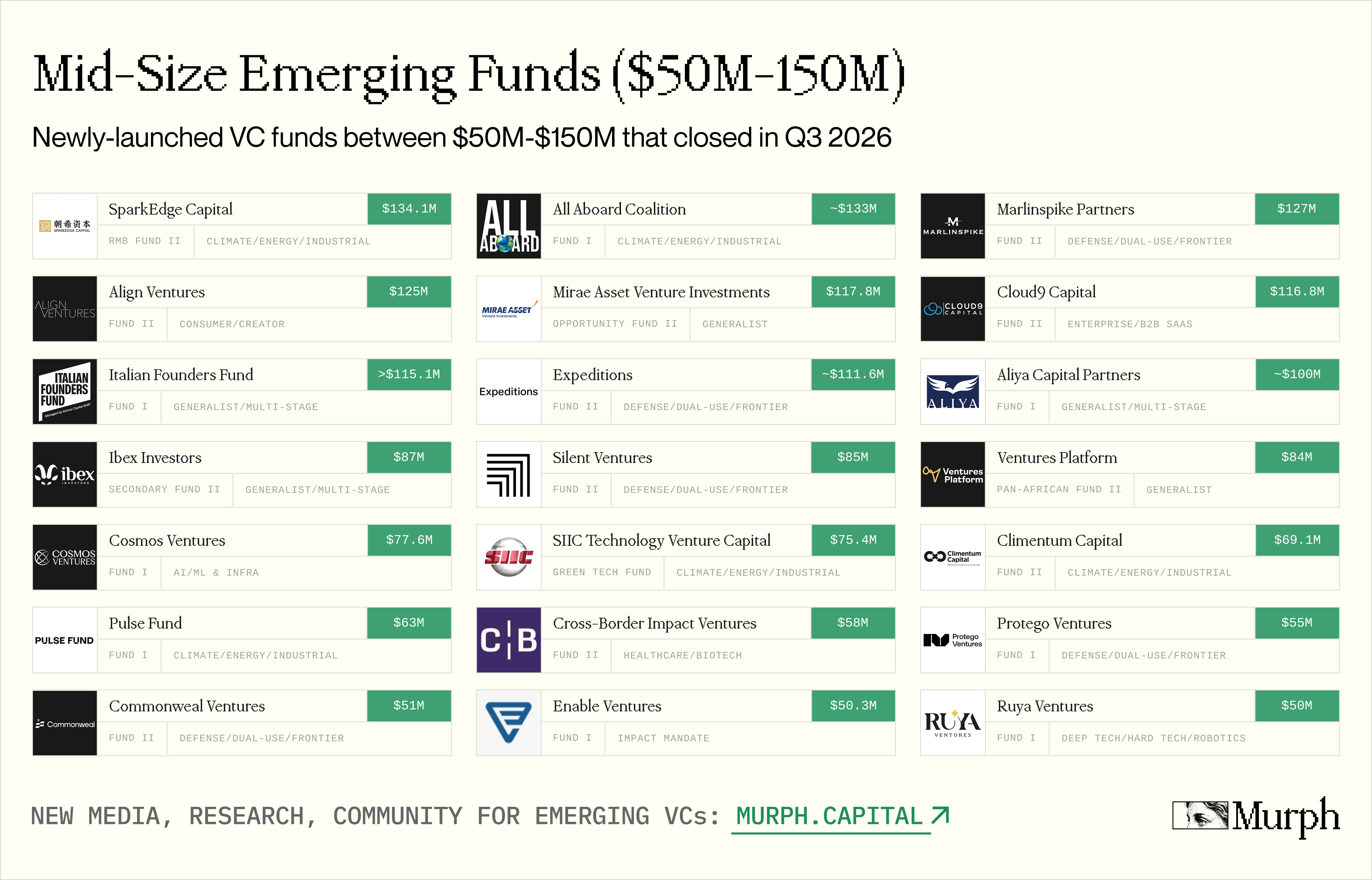
Mid-Size Emerging Funds
Cosmos Ventures ($77.6M, Fund I). Brendan McCord, who built the US Department of Defense’s first applied AI organization and founded the nonprofit Cosmos Institute, launched the firm with Matt Mandel (ex-Union Square Ventures) to back “philosopher-builders” at pre-seed and seed: AI safety and assurance, open-source model infrastructure and products that preserve human autonomy. The LP list reads like a founder network: Reid Hoffman, Fred Wilson, Joe Liemandt and Micky Malka. Early portfolio includes AIUC and Prime Intellect.
Protego Ventures ($55M in Q3, Fund I). The $125M final close sits on top of a $70M initial close announced in late 2024. Israel’s first dedicated defense-tech VC, founded by Lital Leshem, who spent 11 years in the IDF and intelligence community and co-founded Carbyne (acquired by Axon for $625M). Ares Management executives invested $30M personally, and the first portfolio company, XTEND, has just listed on the NYSE.
Italian Founders Fund (>€100M, Fund I). A fund set up by 100+ Italian founders to back other founders, run by Lorenzo Franzi (ex-Global Founders Capital). The LP list reads like a who’s who of Italian tech: Luca Ferrari (Bending Spoons), Riccardo Zacconi (King), Paolo De Nadai (WeRoad). €40M+ already deployed across 32 startups, with Y Combinator and Balderton as co-investors.
Silent Ventures ($85M, Fund II). Solo GP Jackson Moses built and sold 2 startups (MainStreet, Spectrum AI) before launching a pure-play defense fund with a stated focus on kinetics, missiles included, and no “vice clauses”. It writes the largest, sometimes the only, check at pre-seed, then leads or co-leads at seed. GPx, the fund backed by Brian Singerman and Lee Linden, anchors Fund II, and Moses counts 14 defense and deep tech unicorns across Fund I and affiliate vehicles, including Saronic, Castelion, Hadrian and Armada.
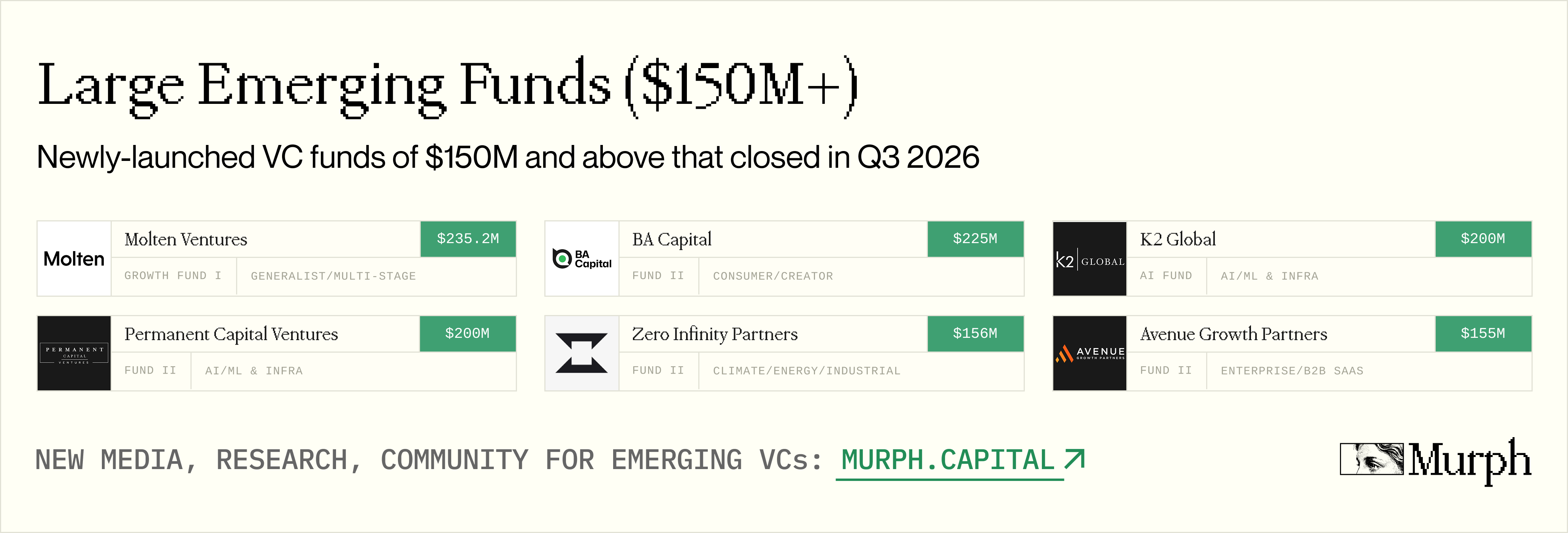
Large Emerging Funds
Zero Infinity Partners ($156M, Fund II). A New York “infratech” firm pairing venture underwriting with infrastructure-style diligence on siting, permitting and project finance. The oversubscribed close is 50% above Fund I, whose holdings include Metropolis (valued above $5B).
Molten Ventures ($235M, Growth Fund I). The largest emerging vehicle of the quarter comes from an established name: London-listed Molten Ventures (formerly Draper Esprit) is raising its first third-party growth fund. The £175M first close of a £350M target is £100M from Molten’s own balance sheet plus a £75M cornerstone from the British Business Bank. CEO Ben Wilkinson’s argument is that UK and European scale-ups lack capital at Series B and beyond, not opportunities. Worth mentioning that it only counts as emerging because our definition is vehicle-level (a Fund I).
Mega Funds
“The mega platforms raised way more than expected this year.”
Harry Stebbings, Founder of 20VC

It’s hard not to agree with Harry. This year, established funds (Fund IV and above) have taken 88.2% of every US venture dollar, the biggest share PitchBook has ever recorded. The average US fund nearly doubled to $165.4M, yet the median kept shrinking and now sits at just $10M. A handful of giants are dragging the average up while everyone else gets smaller.
Harry’s second point shows up in our data too. Accel is back in market only 4 months after closing its $5B Leaders Fund V in April, a16z topped up Growth Fund V from $6.75B to $8.5B within 7 months, and Dimension raised Fund III just 18 months after Fund II. In other words, the top of the market is raising bigger funds and coming back for more sooner.
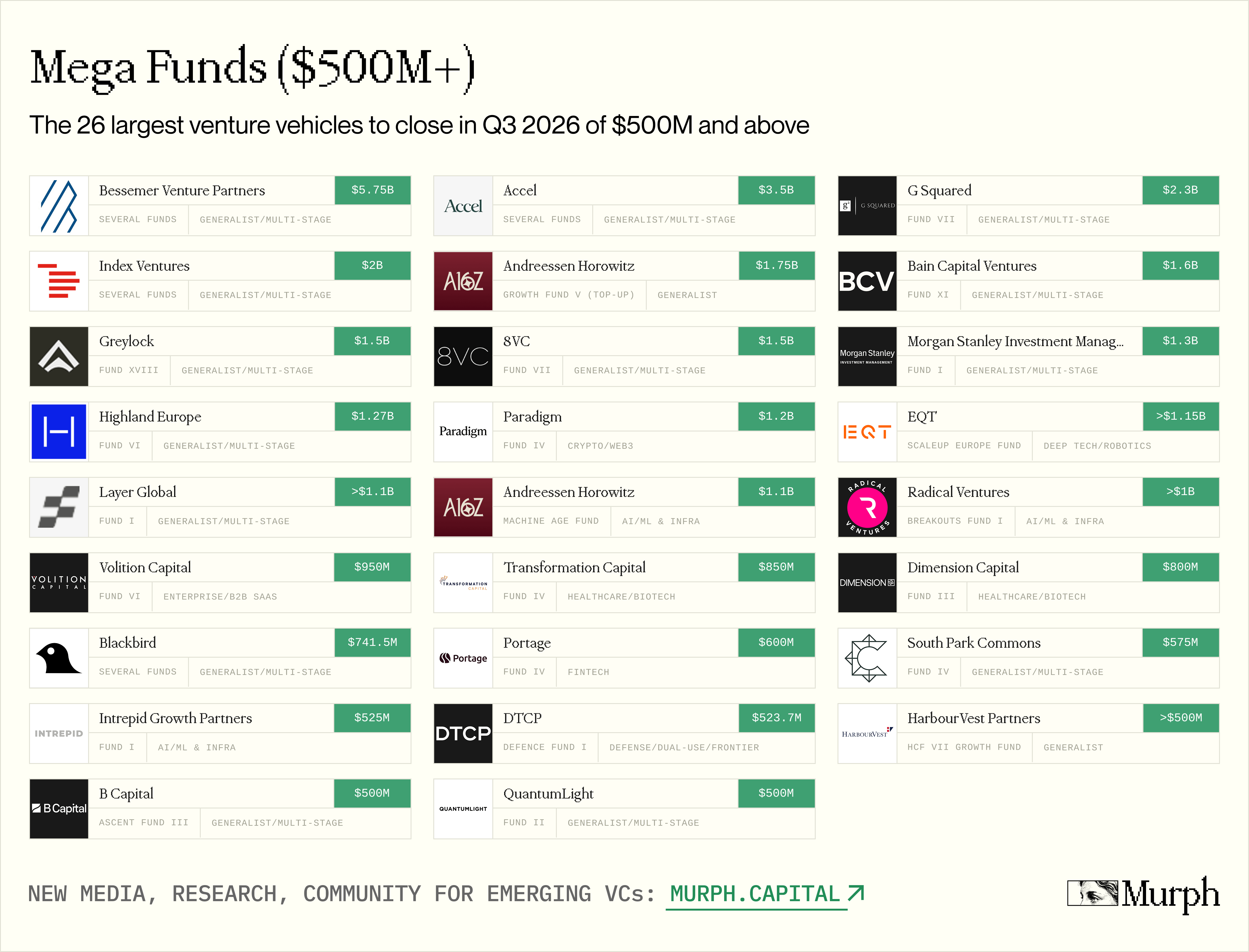
26 funds cleared our $500M bar this quarter, 11 more than in Q2:
Between them, they raised $35.1B, about 3x what the other 126 funds raised combined.
8 sit outside the US: London (Highland Europe, QuantumLight), Stockholm (EQT’s Scaleup Europe), Toronto (Radical, Portage, Intrepid), Sydney (Blackbird) and Hamburg (DTCP).
4 are first closes, so treat them as floors: Scaleup Europe, Layer Global, Radical and DTCP.
12 are growth, secondaries or co-investment products rather than classic early-stage funds, the quarter’s quietest structural shift.
No Chinese platforms this time, versus 3 in Q2. China’s 8 Q3 closes were all RMB funds under $250M.
As in Q2, almost none of these raised on a generic thesis. Below are the 15 largest managers with the story behind each raise, and the rest in a line each.
Bessemer Venture Partners – $5.75B across 2 funds. An AI raise by Bessemer’s own account: the firm says it has put more than $3B into 260+ AI-native companies since 2022, and the new capital tilts up-market, $4B for growth against $1.75B for seed and early stage. The total is about $1.15B above its 2022 raise. Proof points include Anthropic, Ramp, Cognition and Legora on the growth side; Abridge and Perplexity on the early side.
Accel – $3.5B across 4 vehicles. The catalyst is round size. Seed rounds at AI “neolabs” have grown so large that early-stage funds can’t carry them, so Accel created a $1.35B global expansion fund, enlarged its US and Europe/Israel funds to $800M each (from $650M) and shrank India to $550M, as much of the prior India fund is still undeployed. This comes 4 months after Accel’s $5B late-stage close in April.
Andreessen Horowitz – $2.85B across 2 vehicles. A $1.75B top-up took Growth Fund V from $6.75B to $8.5B, the firm’s largest fund ever, on the argument that companies reach growth stage faster and absorb more capital than before. Days earlier, a16z launched a $1.1B Machine Age Fund, its first dedicated hardware vehicle, led by Raghu Raghuram and Martin Casado, for “things that are within the four walls of the data center”: chips, memory, networking, power and robots. Per PitchBook, a16z has raised $23.8B in 2026, more than 20% of all US VC capital.
G Squared – Fund VII, $2.3B. The secondaries fund. VII is about twice the size of 2024’s $1.1B Fund VI and, per Venture Capital Journal, took half as long to raise. It buys direct secondaries, company-led tender offers and structured positions in growth-stage tech, pitched on roughly $240B of global private secondary volume in 2025, up 48%.
Index Ventures – $2B across 3 funds. TechCrunch’s headline says it all: “Fresh off its Wiz payout, Index Ventures raises $2B across three funds.” Index held roughly 12% of Wiz, worth about $3.8B in Google’s $32B acquisition. The raise is a $400M seed fund, a $900M venture fund and a $700M top-up to the 2024 growth fund. We count only the $2B of new money.
Bain Capital Ventures – Fund XI, $1.6B. About 14% larger than the $1.4B Fund X and above target. Partner Slater Stich framed it as funding “life after AGI”: AI infrastructure, physical AI, science, cybersecurity and AI-enabled services. Over 82% of Fund X went into pre-seed through Series B, and Bain Capital’s own staff are among the largest backers.
Greylock – Fund XVIII, $1.5B. Capped on purpose: Saam Motamedi told TechCrunch the firm could have raised a multiple of that. It is 50% above the 2023 fund, and 10 partners will make 1 or 2 new investments each a year. The run behind it: Figma and Rubrik IPOs, Palo Alto Networks’ $3.35B acquisition of Chronosphere and Baseten at a $13B valuation.
8VC – Fund VII, $1.5B. Joe Lonsdale frames it as the “American AI Industrial Revolution” fund: AI, defense, manufacturing and frontier infrastructure. It is 8VC’s largest, about 50% above the $998M Fund VI, with 25-30% reserved for its Build studio (Saronic, Epirus). Exits cited: OpenGov’s $1.8B sale to Cox and Deliverr to Shopify.
Morgan Stanley Investment Management – North Haven Growth & Innovation, $1.3B. An inaugural, oversubscribed growth fund from a bank. Pedro Teixeira’s framing: “Many of today’s leading growth companies are staying private for longer.” It buys through primaries and secondaries, including company-led liquidity programs, and Morgan Stanley and its employees put in 24%. Holdings include Databricks, Anduril and Ramp.
Highland Europe – Fund VI, €1.1B. The catalyst is distributions: more than €1B returned to LPs in 2026 alone from Nexthink’s $3B sale, Huel’s agreed sale to Danone, the EGYM-Playlist merger and the Bending Spoons listing. The British Business Bank is the one LP on the record.
Paradigm – Fund IV, $1.2B. 99% of all crypto fund capital this quarter, and still a mandate widening. It is 52% below the 2021 fund but 41% above 2024’s, and non-crypto holdings now include Zipline and True Anomaly alongside Hyperliquid and Kalshi.
EQT – Scaleup Europe Fund, >€1B first close. The EU’s answer to its own late-stage gap, and the only public-private vehicle in the tier. The European Commission anchored the first close with €1B against a €5B target, alongside Allianz, APG/ABP, CriteriaCaixa, Novo Holdings and Santander. Even TechCrunch called it “unclear how much capital Scaleup Europe has raised so far”, so €1B is a floor. Its first deal was co-leading ICEYE’s €1B Series F with General Atlantic.
Layer Global – debut fund, >$1.1B first close. Anton Levy, formerly co-president of General Atlantic, launched Layer Global in February with a $1.1B target, and The Information reports the first close already exceeds it. The strategy is concentrated AI growth positions in companies with $50M-$100M+ of revenue growing 100%+.
Radical Ventures – Breakouts Fund, >$1B first close. A late-stage AI fund announced at Canada Investment Summit, with a “multi-billion” target, the first close alone exceeds Radical’s entire 2024 growth fund. LPs include CPP Investments, PSP, HOOPP, TD and BMO.
Volition Capital – Fund VI, $950M. Closed at its hard cap, oversubscribed and 41% above Fund V, for founder-owned, capital-efficient software companies, with Chewy’s 2019 IPO as the headline exit.
The other 10:
Transformation Capital ($850M, Fund IV): digital health, 8 AI investments in a year.
Dimension ($800M, Fund III): science-and-compute, 60% larger than a Fund II raised 18 months earlier.
Blackbird (A$1.05B): returned A$2.25B on A$3B invested; Eucalyptus’s sale returned its 2018 fund twice over.
Portage ($600M, Fund IV): the only mega fund smaller than its predecessor.
South Park Commons ($575M, Fund IV): 2.1x Fund III, for follow-on capital.
Intrepid Growth Partners ($525M, Fund I): ex-CPP CEO Mark Machin’s debut, backed by state capital from 4 countries.
DTCP (€455M, Defence Fund I): Europe’s rearmament fund, anchored by Deutsche Telekom and Porsche SE.
B Capital ($500M, Ascent III): nearly double Ascent II, despite the name a multi-sector fund.
QuantumLight ($500M, Fund II): Nik Storonsky’s model-driven firm doubled its debut.
HarbourVest (>$500M): a growth sleeve inside a $4.75B co-investment programme.
Verticals Breakdown
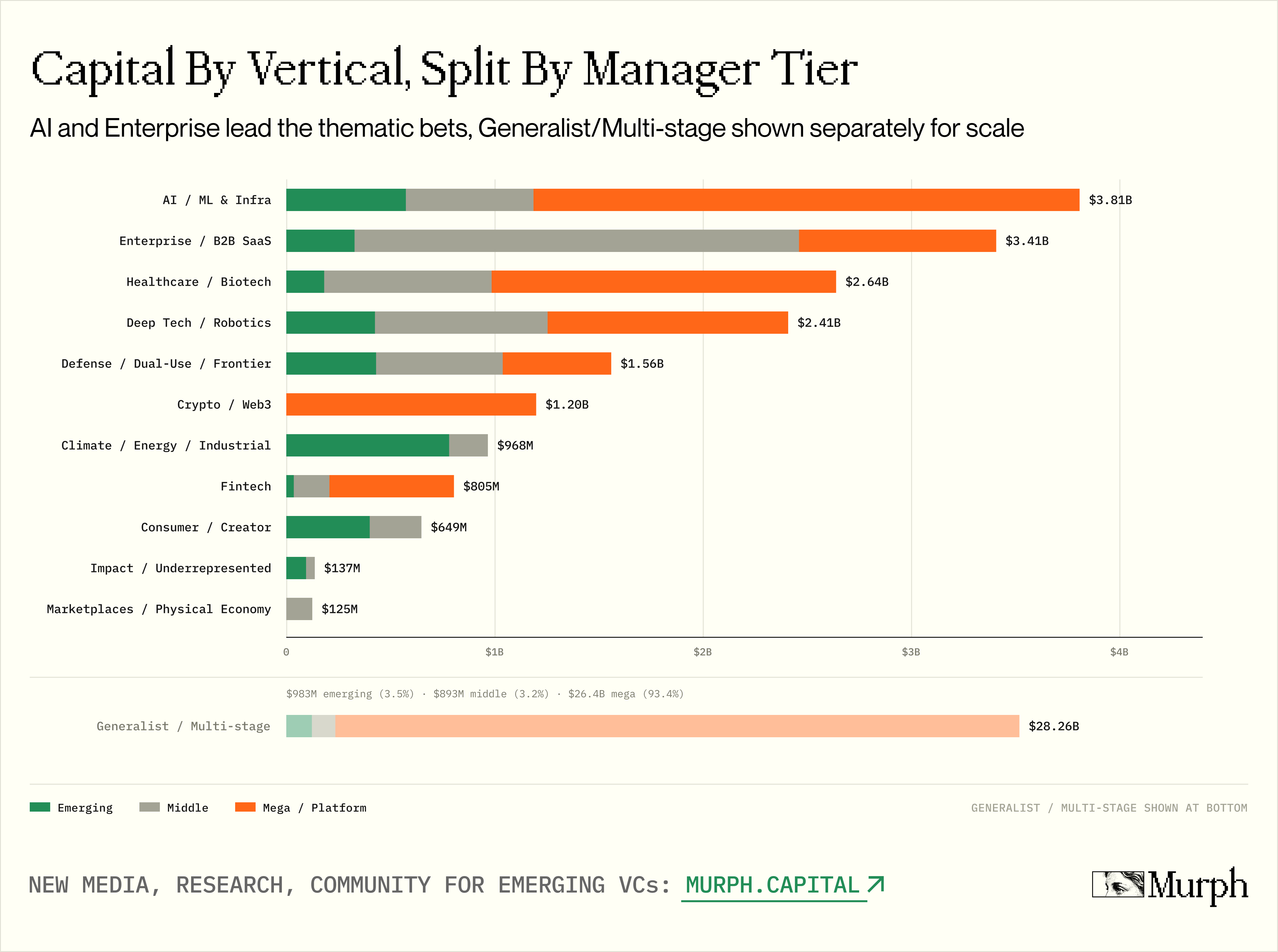
Strip out Generalist/Multi-stage funds (61% of dollars, but not a sector bet) and look at where actual thematic conviction went this quarter:
AI/ML & Infra – $3.81B across 15 funds, but top-heavy: a16z’s Machine Age Fund, Radical’s Breakouts Fund and Intrepid are 68% of it. Worth mentioning that we only tag a fund AI when AI is its stated mandate, so Bessemer, Accel and Greylock count as generalists.
Enterprise/B2B SaaS – $3.41B across 15 funds, the healthiest “middle” in the dataset: $2.1B sits in Middle-tier funds like Crane, Jump Capital and Team8, below Volition’s $950M.
Healthcare/Biotech – $2.64B across 15 funds, over 60% of it from Transformation Capital and Dimension.
Deep Tech/Hard Tech/Robotics – $2.40B across 22 funds, the largest category by count. EQT’s Scaleup Europe is almost half of it, then Matter Venture Partners’ $450M fund backed by TSMC and ASML, then a long tail of seed funds in China, India, the UK and Korea.
Defense/Dual-Use/Frontier – $1.56B across 10 funds, up from $1.27B in Q2. Emerging managers put in $430M, not far behind the middle ($609M) and mega ($524M, all DTCP) tiers: Marlinspike, Expeditions, Silent Ventures, Protego and Commonweal are all debut or sophomore funds.
Crypto/Web3 – $1.20B, but 99% is Paradigm. In Q2, 3 franchises re-upped for $3.9B; Q3 shows the category without them.
Climate/Energy/Industrial – $968M across 16 funds, and not a single mega fund among them: 15 of the 16 are emerging funds.
Fintech ($805M, three-quarters of it Portage), Consumer/Creator ($649M), Impact ($137M) and Marketplaces ($125M) rounded out the quarter.
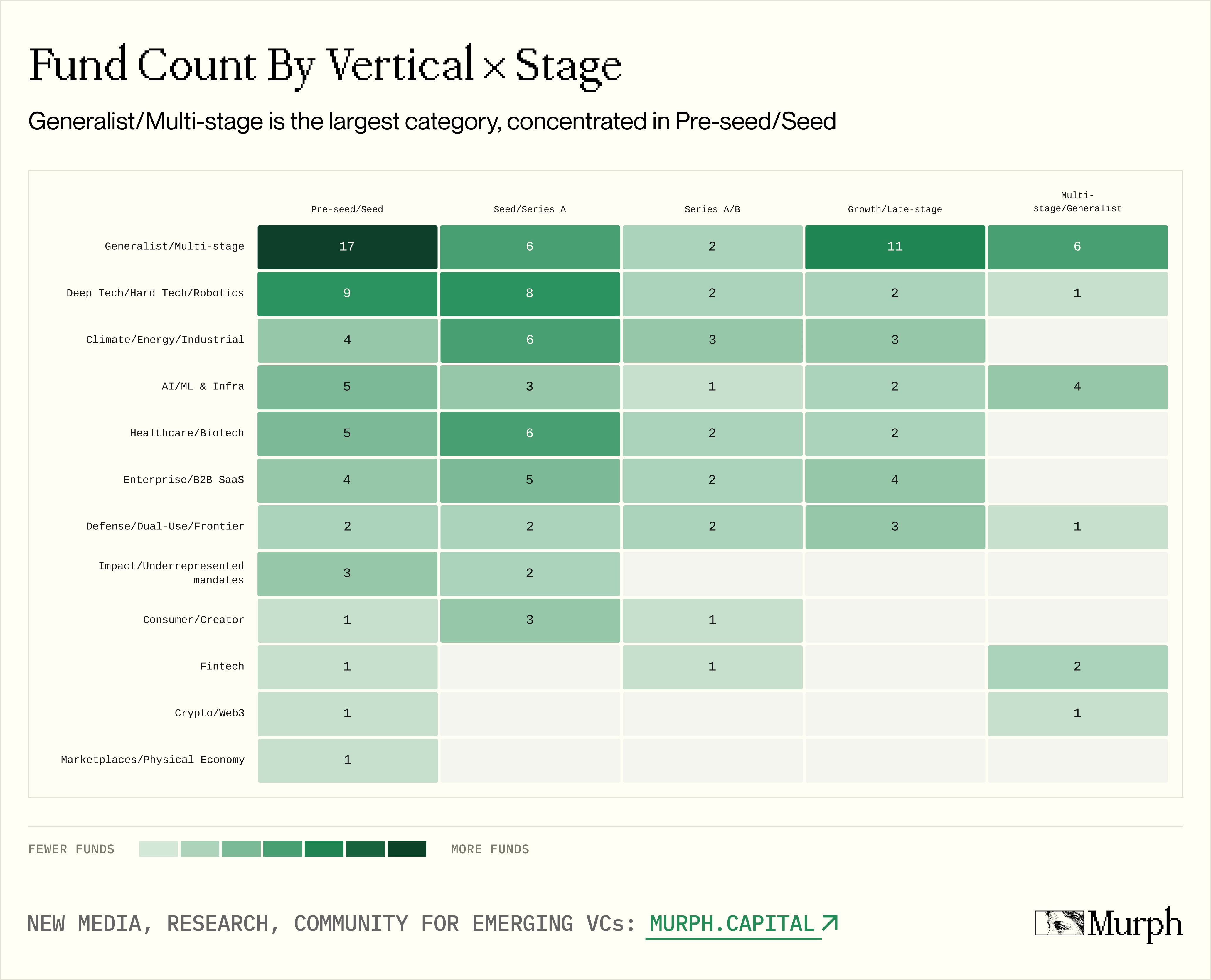
By stage, 94 of 152 funds enter at seed or earlier, but the money sits in the 27 growth funds: 13 of the 26 mega funds are growth vehicles. Emerging managers’ sector mix, once again, looks nothing like the market as a whole:
Climate is 18% of emerging dollars versus 2% of the market, Defense 10% versus 3%, and Consumer/Creator 9% versus 1%.
Generalist/Multi-stage is 23% of emerging dollars versus 61% of the market.
In other words, the mega tier is buying AI exposure through generalist platforms and growth funds, while emerging managers build the categories (defense, climate, hardware) the platforms aren’t chasing with dedicated vehicles.
Geographic Breakdown
Geographically, Q3 was a US story with a Canadian subplot:
The US and Europe combined for 96 of 152 closes (63%) and $39.8B of the $46.0B tracked (87%).
Canada, Asia, Australia/NZ, Israel, India, Latin America and Africa split the remaining 13%, with Canada alone taking more than a third of that.
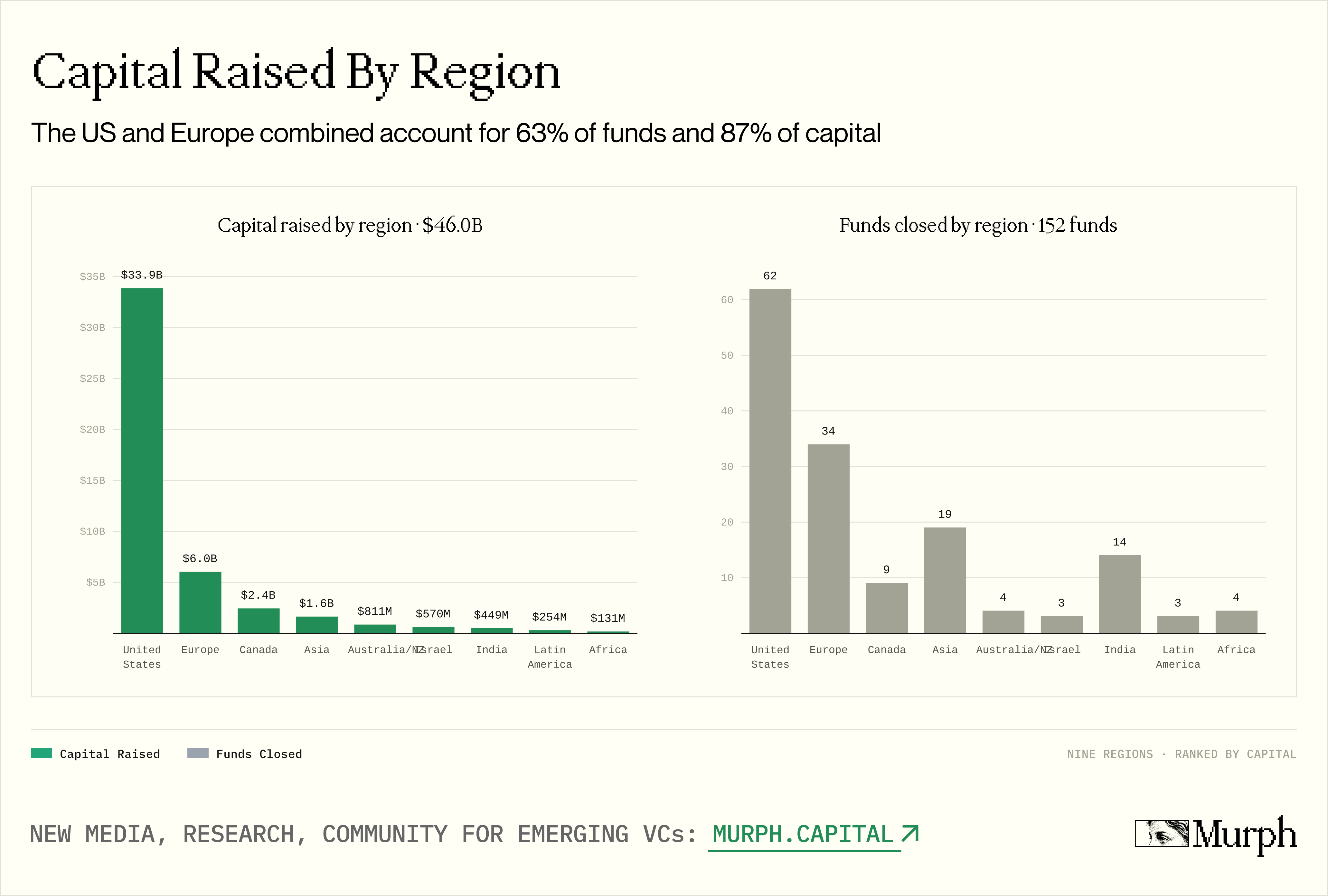
United States: 62 funds, $33.9B – home to 18 of the 26 mega funds.
Europe: 34 funds, $6B – 55% of the US’s fund count (76% in Q2) but 18% of its dollars, a 5.7x gap. The UK did half the work: 13 funds and $3.0B, led by Highland Europe, QuantumLight and Crane. HSBC Innovation Banking and Dealroom called Q3 the UK’s strongest fundraising quarter on record at $6.9B; their figure counts Index as a UK manager at its full $3.5B, which explains most of the gap with ours. Outside the UK the map was thin: Germany’s $571M is almost all DTCP. Public capital is still doing a lot of the work underneath: the British Business Bank appears on 5 funds, the European Investment Fund on 5 and Denmark’s EIFO on 4.
Canada: 9 funds, $2.38B – the quarter’s outlier. Radical, Portage and Intrepid were announced within 5 days of each other around the Canada Investment Summit, all backed by Canadian pensions, crown corporations or banks. Canada raised 40% of what all of Europe did, on about a quarter of the fund count.
Asia: 19 funds, $1.56B – China’s 8 funds ($882M) were all RMB and all under $250M, a sharp contrast with Q2’s 3 USD mega platforms. South Korea’s 6 were mostly government-seeded regional vehicles, with Stonebridge’s KRW 325B AI fund the exception, and Singapore, Japan and Taiwan made up the rest.
India: 14 funds, $449M – more funds than Asia ex-China, but small ones, and 4 are explicitly “frontier tech” funds chasing defense, space and semiconductors.
The rest of the map: Israel closed 3 funds ($570M, all cyber, enterprise or defense), Australia/NZ 4 ($811M, 91% Blackbird), Latin America 3 ($254M, all Brazilian, after zero in Q2) and Africa 4 ($131M, all emerging, 3 of them DFI-backed).
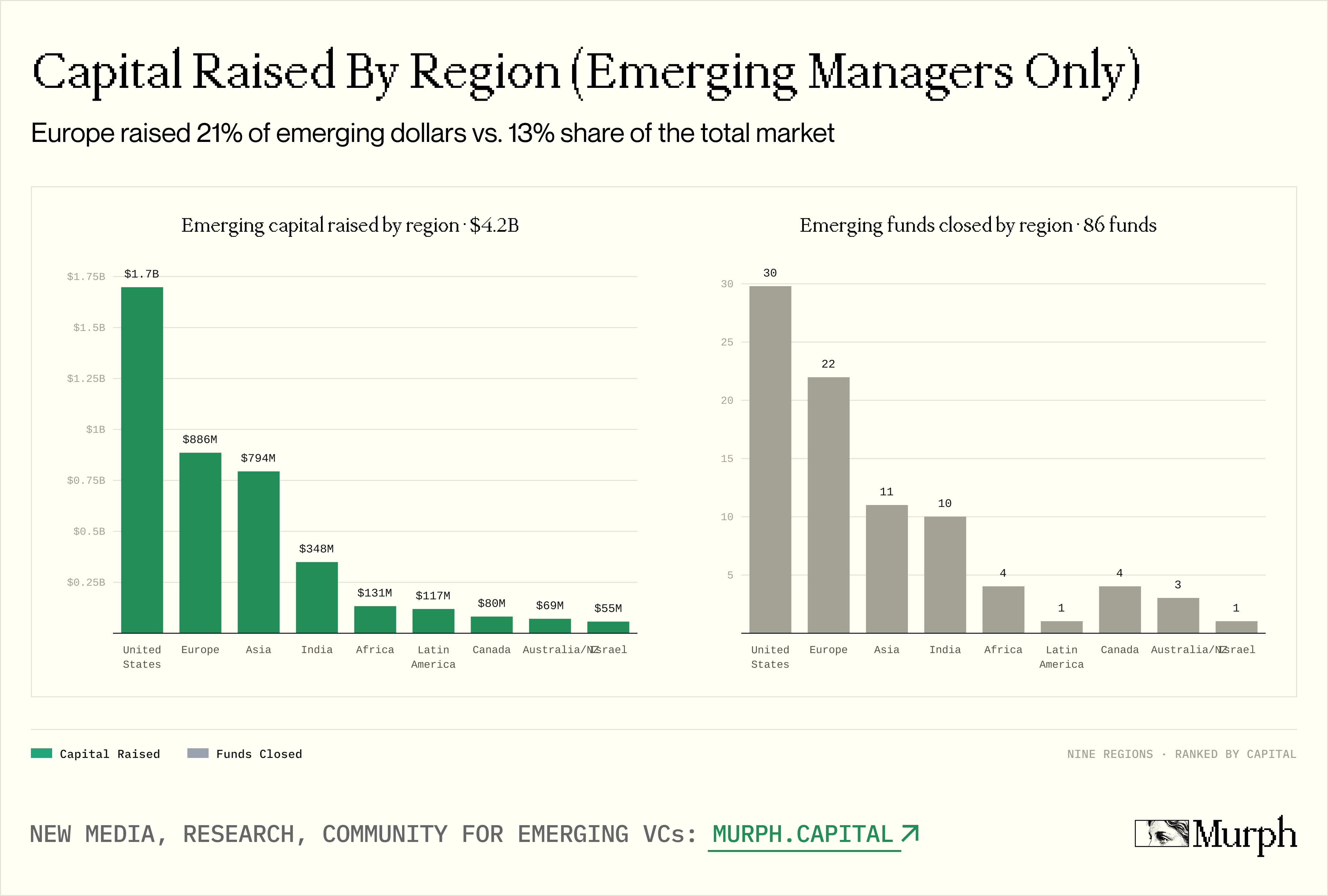
Emerging managers’ geographic mix skews differently:
The US still leads, but with just 41% of emerging dollars, against 74% of the total market.
Europe punches above its weight here: 21% of emerging dollars, against 13% of the total market.
Asia (19%) and India (8%) follow, driven by Chinese RMB Fund IIs and India’s frontier-tech debuts; India is only 1% of the overall market.
Capital Concentration
Another key dynamic worth highlighting is whether the barbell we described in Q2 is still there. We split all 152 funds into the same 3 buckets: Emerging (Fund I or II, under $250M), Mega (any fund at $500M+) and Middle (everything else).
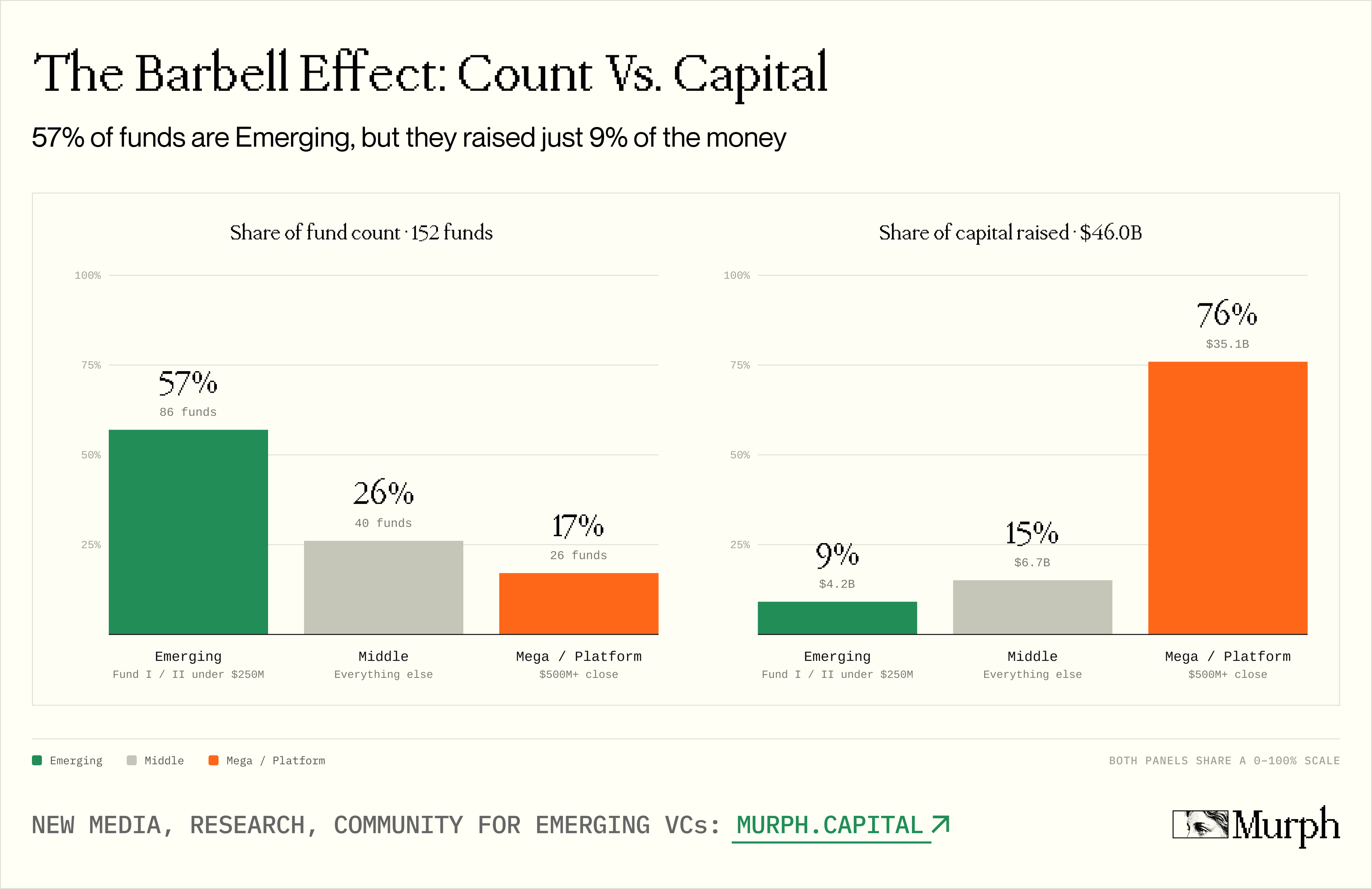
The barbell got heavier on one end:
By count, it is the familiar power law: 57% Emerging, 26% Middle, 17% Mega.
By dollars, 17% of the funds absorbed 76% of the capital, while the 57% on the smaller end shared 9%.
Both ends gave ground: the emerging share of dollars slipped from 13% to 9%, the middle from 18% to 15%, and that money went to the top. PitchBook sees the same squeeze in the US: the number of distinct emerging firms closing a fund fell from 927 in 2022 to 211 through Q3 2026.
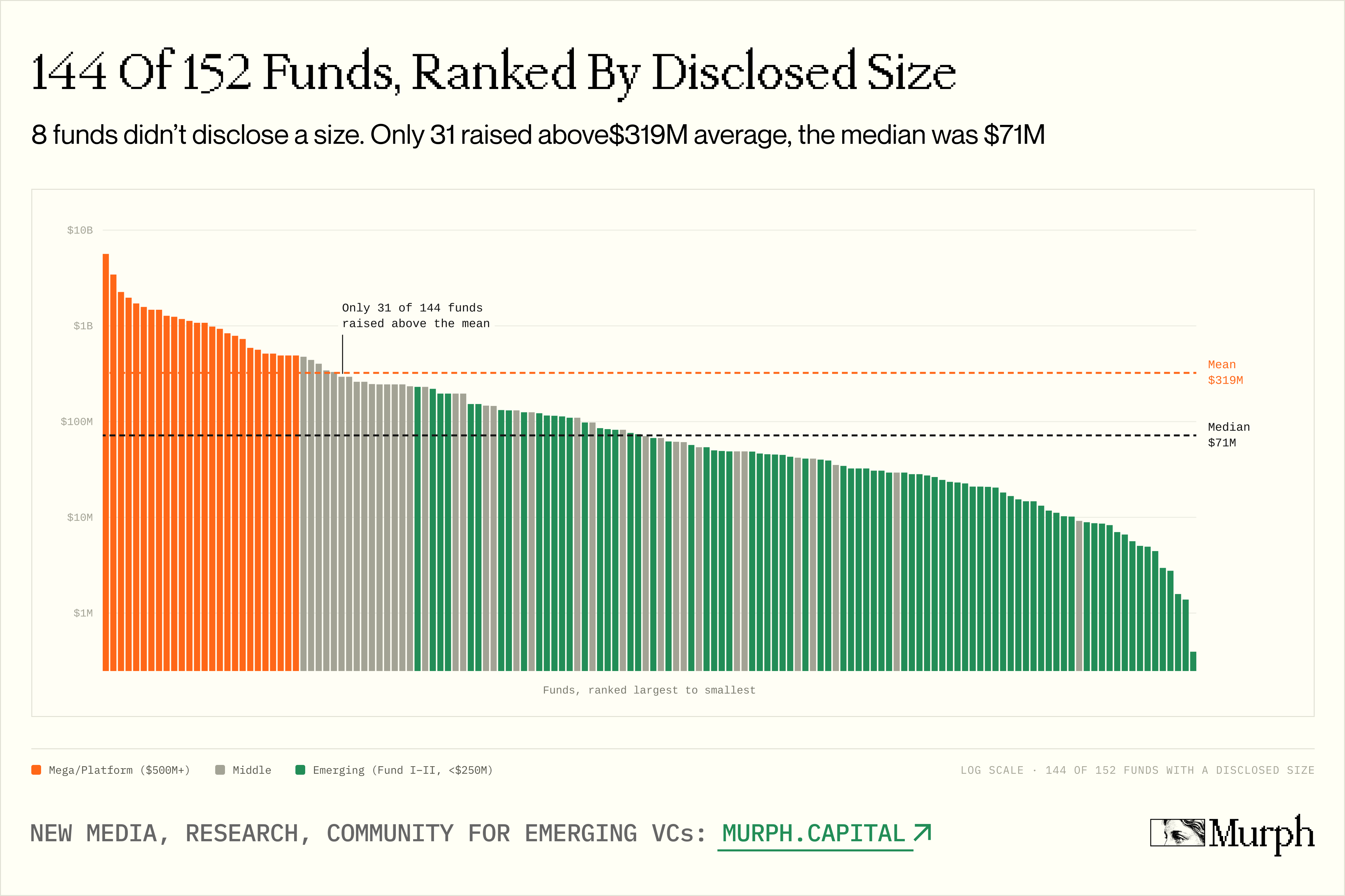
The median-vs-mean gap tells the same story: a $71M median against a $319M average. Only 31 of the 144 funds with a disclosed size raised above the mean, so a $100M fund was in the top half of the quarter and still raised less than a third of the “average” fund. Not exactly what “average” is supposed to mean, right?
LP Analysis
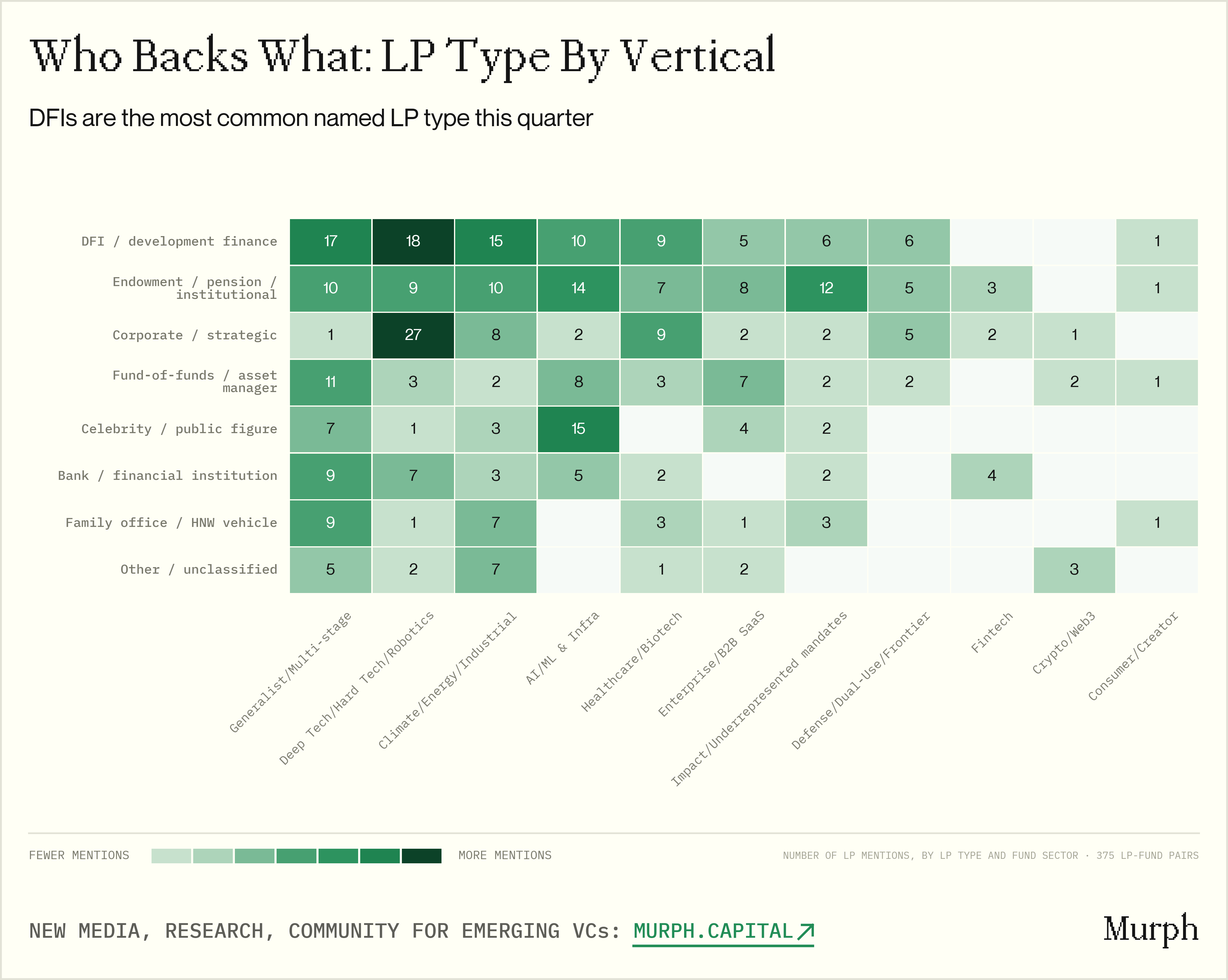
Of the 152 funds we tracked, 83 disclosed at least one named LP. We normalized those mentions (375 LP-fund pairs across 351 unique allocators), classified each one, and uncovered a few interesting insights:
Development finance institutions are again the most common LP type, on 41 of the 83 disclosed cap tables, led by the European Investment Fund and the British Business Bank (5 funds each) and Denmark’s EIFO (4). But the DFI story is no longer just European: 23 of 87 DFI mentions are Asian guidance funds, 15 are African (IFC, BII, Norfund, Proparco) and 9 are Canadian. Only 4 are on US funds. If you’re an emerging manager outside the US, a development bank is still a more realistic first conversation than a US endowment.
Pensions, endowments and foundations are a close second (37 funds) and the most geographically spread, from UK local government pensions on Clean Growth Fund to Australian supers on Blackbird. Foundations anchor several impact and climate funds.
Corporates write checks close to their own core business, and this quarter that business is hardware: 27 of 59 corporate mentions sit on Deep Tech funds, from TSMC and ASML on Matter Venture Partners to Aker and Halliburton on Norway’s RunwayVC.
Founder money is small and concentrated: 24 of 32 celebrity and founder mentions sit on just 4 debut funds (Activate, Cosmos Ventures, the Italian Founders Fund and NewSchool VC), each using a founder network as its anchor LP base.
Mega funds barely disclose. Only 8 of 26 named a single LP, and 7 of those 8 are non-US. Emerging funds disclosed at 64%, mega funds at 31%, so the LPs we can see skew toward the small end of the market by construction.
Outside the DFI cluster, this market isn’t being carried by a small set of repeat backers. Of the 351 uniquely named LPs, only 16 backed more than one fund this quarter, and only 3 backed 3 or more (EIF, BBB, EIFO), all of them public. Taken together, the LP side mirrors the fund side: public capital outside the US, corporates in their own sectors, founder networks on a handful of debut funds, and almost no visibility into who writes the $500M+ checks at the top.
By analogy with the previous edition, for readers who support us with a monthly subscription we've put together the full list of all 351 LPs mentioned in this report as a living Google Sheet. Thank you for being part of this journey and help keeping this research going.
If you want reports like this straight in your inbox, and want to keep track of what's actually happening in emerging VC and LP land, subscribe to Murph Capital.
VC isn’t returning to normal; it’s returning to concentration. Large funds absorb almost everything, emerging managers survive on what’s left, and the middle market is evaporating. Power in venture is no longer distributed. It’s centralized.
Europe raising 18% of the US total, with the gap widening from 4x to 5.7x in a single quarter, is the number I'd watch. With emerging funds down to 9% of capital, my guess is European pre-seed founders feel it first, since debut funds are often the ones writing first cheques.