



Election to the Royal Society required 2 types of endorsement:
A certificate needed 6 or more signatures, with at least 3 Fellows signing from personal knowledge, meaning those who worked with the candidate.
The rest might be contributed from general knowledge, by others who are familiar with the work but not the person.
The certificate for Percy Alexander MacMahon, an army commander and mathematician, was posted on February 26, 1889. 12 signatures, 9 from personal knowledge, 2 of whom were Arthur Cayley and J. J. Sylvester, who jointly dominated British mathematics. Impressive, right?
If he were an emerging manager today, this would be called an oversubscribed first close with 2 tier-one anchors. It did not get him elected, though. The certificate was fine, yet he fell victim to another rule.
Since the late 1840s, the Council could only send 15 names each year. He was not among them. His proposal was resuspended, the Society's word for putting it back up. 15 months later there was room for him, and he was elected on 5 June 1890.
By the standards of anyone raising a fund, the Society was generous. Rules and limits were known, the calendar said when the next window would open, and MacMahon was told where he stood. A GP raising Fund I gets none of that.
In Part I we looked at 132 active funds of funds with venture exposure noticeable enough to be included, divided them into 4 archetypes. Of those, 33 had emerging managers as their core thesis.
The gap between 132 and 33 is why segmentation matters. An aggregate can describe the market accurately yet ignore the part of it an emerging manager can actually reach.
Market segmentation should always be kept in mind in the EM context. In July, the PitchBook-NVCA Venture Monitor reported that the median time to close a US venture fund had fallen to 6.4 months in the first half of 2026, from 15.1 months in 2025. On its face, the best fundraising news in 3 years, which, frankly, looks anomalous (nearly 3X faster than in Q3 2025 and close to the top quartile for that year).
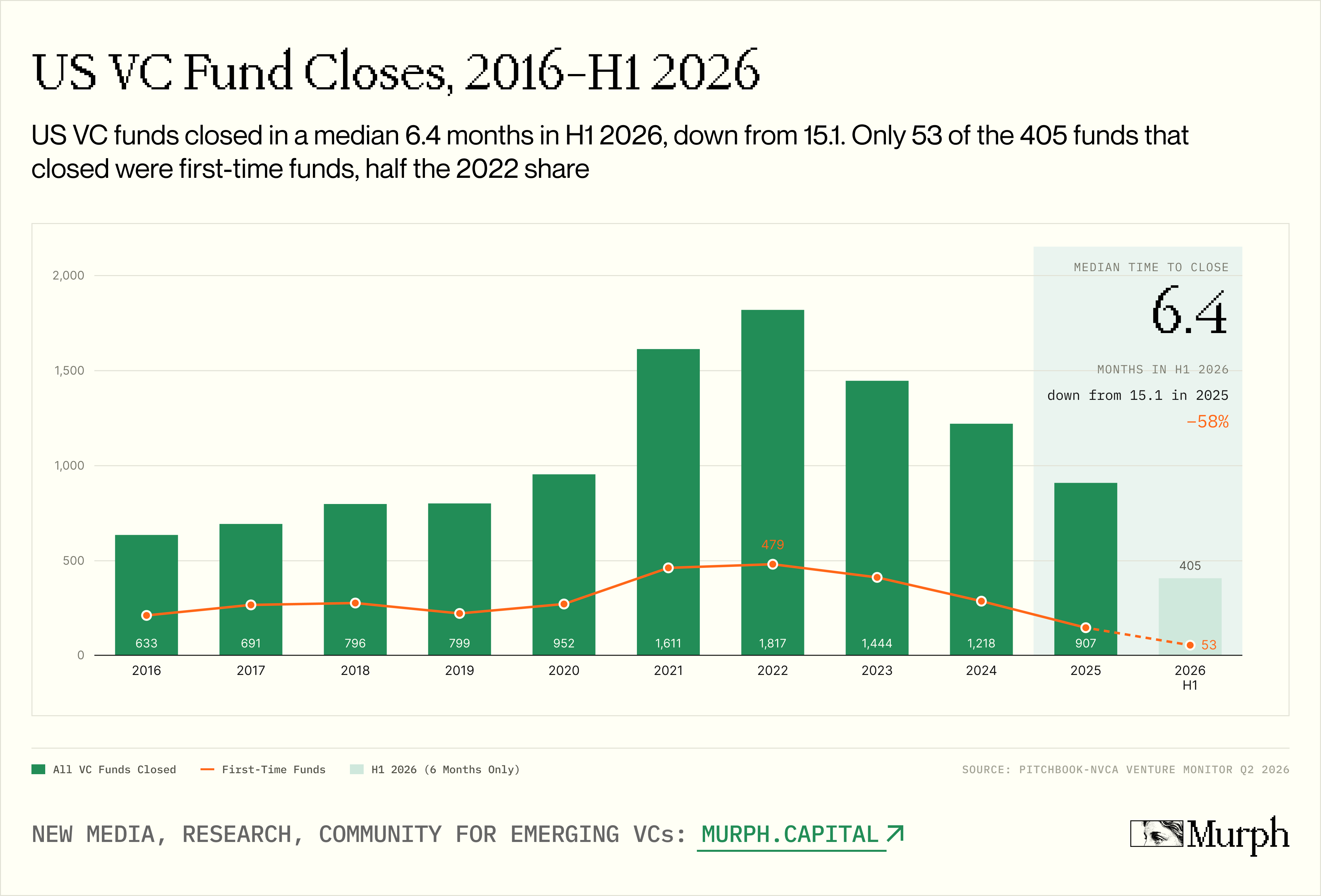
The reality, though, is that the market for EMs is still tough. The faster pace is best read as a signal of which funds are reaching a close. The vehicles closing today are disproportionately the well-positioned, established funds that LPs are eager to back, while much of the broader market has slowed or stopped fundraising.
We already wrote about this earlier. Our own Q2 2026 fundraising data shows the same split:
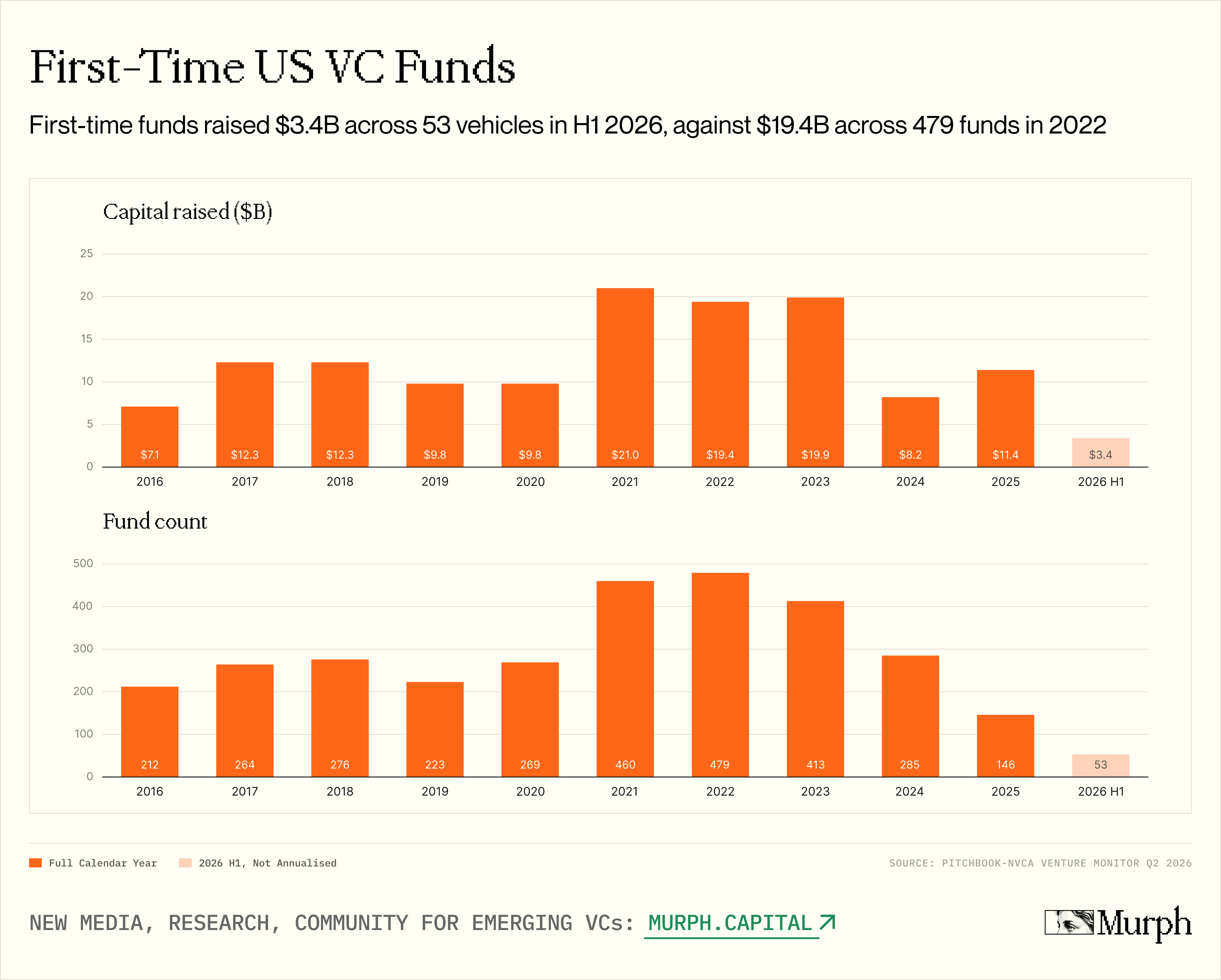
Sequoia's $7B close alone outraised the quarter's 76 debut and sophomore funds under $250M combined.
Those emerging managers made up 55% of the 137 closes but took just 13% of the $39.3B raised, while 15 funds above $500M took 69%.
After all, the quality of MacMahon’s endorsement was never the issue. Fellows, including Britain’s 2 most influential mathematicians, had signed based on personal knowledge, but the Council still rejected him. So whatever decided his case, it was not the quality of his mathematics or the strength of his sponsors. In VC terms, the problem was neither the thesis nor the people backing it.
This is the aspect of institutional fundraising that emerging managers often overlook. Securing an internal advocate is surely the hardest part of the process, but it is not the final one. Lindel Eakman, now at Eden Road Capital, 20 years into backing emerging managers, described the ceiling in 2021:
"I love our Partner Fund group and only wish that we could have more slots to engage and support beyond our bandwidth and capital limitations."
Lindel Eakman, Investing in & supporting Emerging Managers (2021).
The difference between our little analogy and real life is that The Royal Society published its limit of 15 yet institutional investors don’t. That is exactly limitations we faced while working on the Part I, a market map shows which institutions exist and what they claim to do, yet it cannot show either the advocate or the room.
We poured blood, sweat and tears into Part II to make it genuinely useful for emerging managers. Here we go deeper, well as deep as public data allow, to get to the specific players actively looking to anchor Fund I and Fund II, the check sizes they write, the managers they have genuinely backed, the DNA and backgrounds of the decision-makers on their investment teams, and which new relationships you should target.
In Partnership With

Legion is a high-signal marketplace matching emerging GPs with relevant LPs, featuring seamless fund admin, built-in secondary liquidity, and over $300M in investor capital flows.

Harmonic aggregates real-time data on 30M+ companies and 190M+ people to surface the signals that actually matter – all through AI-powered workflow.
Rho is a modern financial platform for VC-backed startups and emerging fund managers. Banking, cards, treasury – built for how capital moves through venture.
Cura is a VC portfolio intelligence on autopilot that connects your Granola notes, iMessage, LinkedIn data and more to automate support and intelligence.
Wonderstruck is the storytelling and design studio venture-backed companies call when they outgrow their brand. Trusted by 1517, Kindred, Sunflower & 200+ founders.
I. The Landscape
The original dataset from Part I included 132 active funds with 33 being emerging manager focused, 40 being classic FoFs, 30 hybrid FoFs, and the remaining 29 government-led. That split did not imply that every firm sat cleanly inside one box or that emerging-manager relevance was limited to the specialist category.
We have continued working on the dataset (which grew to 146 funds) with the feedback received after Part I was published, reclassifying some of the funds, adding a couple of new ones and deleting those that were really accelerators or sleeves inside broader capital management firms.
As this part of the research focuses solely on those FoFs whose focus, or in this section better to say declared focus, is devoted solely or largely to EMs raising Fund I, II or III, the landscape is even narrower than the original one.
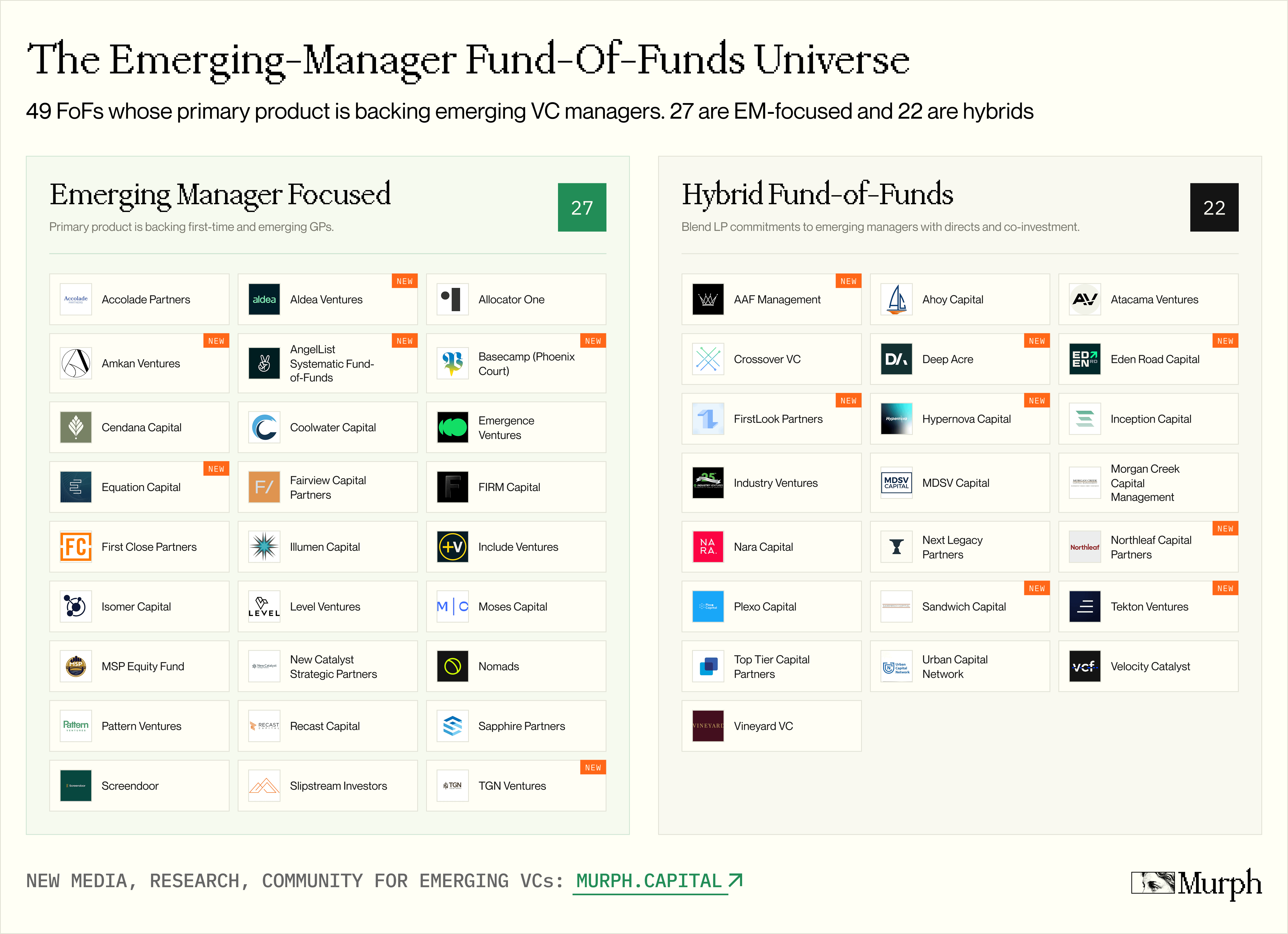
After dataset validation against multiple indicators, such as LP base, EM relations, deal traction, and so on, we stopped on 49 funds that pass both tests we set: (1) they make primary commitments to venture funds, and (2) backing emerging managers is their primary product rather than a side allocation.
Well, distinction is not always clear as some funds from the Emerging Manager Focused basket also deploy capital into co-investments and direct investments but it does not make them automatically hybrids. To handle that, we tried to add some extra tests. Thus, we classify a fund as Emerging Manager Focused when:
Its fund selection product primarily targets first-time, early-generation or emerging managers
Direct or co-investments are selective follow-ons derived from the manager’s portfolio or housed in a separate affiliated vehicle
The Hybrid Fund-of-Funds type is used when:
Fund and company investing are genuinely co-primary within the product
Direct investing is the majority strategy and fund commitments are a minority share
Applying this tests gives us 27 dedicated emerging-manager funds of funds and 22 hybrids that pair fund commitments with direct or co-investment capital.
And even with these extra tests, drawing a crystal-clear line between a hybrid fund-of-funds and a dedicated emerging-manager specialist remains inherently complex. We are certain that once this report is out, we’ll see a lot of feedback on these classifications, and we welcome the conversation.
7 gates for EMs
However, 49 identified FoFs does not mean that EMs can get access to all of them. Access is often constrained by bandwidth, capital limitations, mandate, vehicle state, and other factors. We thought about the best way to frame the gates EMs face from what we saw across the data and arrived at the following:
Entity – the named FoF still operates the program
Product – its product is primary fund commitments
Mandate – geography, stage, sector, and fund number cover you
Economics – its check fits your fund size without an ownership problem
Vehicle state – there is an active vehicle with capital left to deploy
Evidence – you can see what it looks for
Route – there is a realistic way in, whether through warm intro or cold outreach
Addressability comes down to all 7 conditions being met at the same time. Economists call this an O-Ring production function. If the inputs work together, one weak link can drag the whole thing down.
For an emerging manager it means that, in an already tough market where most LPs’ money is absorbed by $1b+ mega-funds, the addressable universe continues to shrink. The access for EM is clear when several factors align at once, or you repeat MacMahon’s story, where the route was strong yet there was no room. The idea, obvious as it may be, is that the market for emerging managers is even smaller than the already tiny FoF universe.
5 lenses for FoFs
Part I divided FoFs into 4 archetypes, 2 of which, with the corrections discussed earlier, migrated to this part. Archetypes, however, are broad strokes that reflect what FoF is principally built to do and tell an EM little on a deeper level, so we dug deeper and split the 49 FoFs into 5 lenses.
We chose these 5 because each one answers a question an emerging manager should ask before the first call:
Does this allocator back new managers on purpose?
Does my fund or founder base fit a mandate it already has?
Where is it based?
Is it building its own track record at the same time as I am?
And does it want access to my companies as well as my fund?
That is just one way to look at this and alternative views on it are definitely possible. Here is how we framed this classification:
The Specialists: 35 of 49. EMs are the core thesis itself. These allocators chose the Fund I sandbox on purpose, betting that the structural risk is precisely where the extra alpha lives.
The Diversity Mandate: 15 of 49. Diversity is part of the thesis. These allocators deliberately back underrepresented managers, funds investing in underrepresented founders, or both.
The International Players: 12 of 49. 12 keep their head office outside the United States: Vienna, London, Berlin, Munich, Zurich, Barcelona, Brussels, Toronto and Dubai. The other 37 are American. However, a FoF’s HQ does not define its geographical reach, which we’ll touch upon a bit further on.
The New Guard: 30 of 49. More than half the universe was founded in 2020 or later. These are young FoFs backing a similarly young generation of EMs, with many still building out their own portfolios, networks, and track records.
Direct or co-investment: 38 of 49. Most can invest in companies as well as funds, making direct access and deal flow an increasingly common part of the FoF model. The manager is no longer always the end product as the companies behind them matter too.
We have spotted some interesting dynamics across our data:
The specialist and the young firm are mostly the same firm. 28 of the 30 New Guard firms are specialists, and only 7 of the 35 specialists were founded before 2020. The LP most likely to back your Fund I is often about as young as your fund and still building a track record of its own.
Fund-only is the exception. 38 of the 49 also invest in companies, including all 14 sleeves. Only 11 firms, all of them specialists, underwrite your fund and nothing else. Expect your fund to be read partly as deal flow.
The diversity mandate is mostly an American product. 13 of the 15 diversity-mandate firms are headquartered in the US, and 6 of the 15 are sleeves inside larger platforms. Only Allocator One and Basecamp carry both the Diversity and International lenses.
Worth mentioning that these are lenses, not distinct buckets. A fund can have a diversity mandate, be founded after 2020, have a non-US headquarters and do co-investments all at once.
The 5 single-lens firms, AAF Management, Industry Ventures, Morgan Creek, Tekton, and Top Tier, are all older US platforms. In those, emerging managers sit inside a broader investment platform built around direct or co-investment. Here is the pattern, for many established FoFs, the manager is only one way into the underlying companies.
Who’s Actively Deploying?
It’s great that we have a general understanding of who is in the addressable universe and what lenses can be applied to them, but none of this is particularly useful for EM fundraising if the FoF does not have an actively deploying vehicle.
So, the next question is who is deploying now. We collected all publicly announced commitments in a 36-month window (31 August 2023 to 31 August 2026) with commitment dated by the when it became public and used the FoFs’ own fundraises, as a proxy for anticipated activity. If the capital is raised it needs to be deployed, right?
Not every FoF leaves a clear public trail to verify their vehicle’s active status, so we sorted all 49 into 3 groups by the strongest evidence we could find for each.
Named commitment. A single dated public source names the FoF, the fund it backed, and the commitment itself.
Recent proxy. There's no named commitment in the window, but the FoF has raised or launched its own vehicle recently, which suggests capital waiting to be deployed.
Older or undated. No named commitment and no new vehicle inside the window. The most recent public evidence is either more than 36 months old or has no date we could verify.
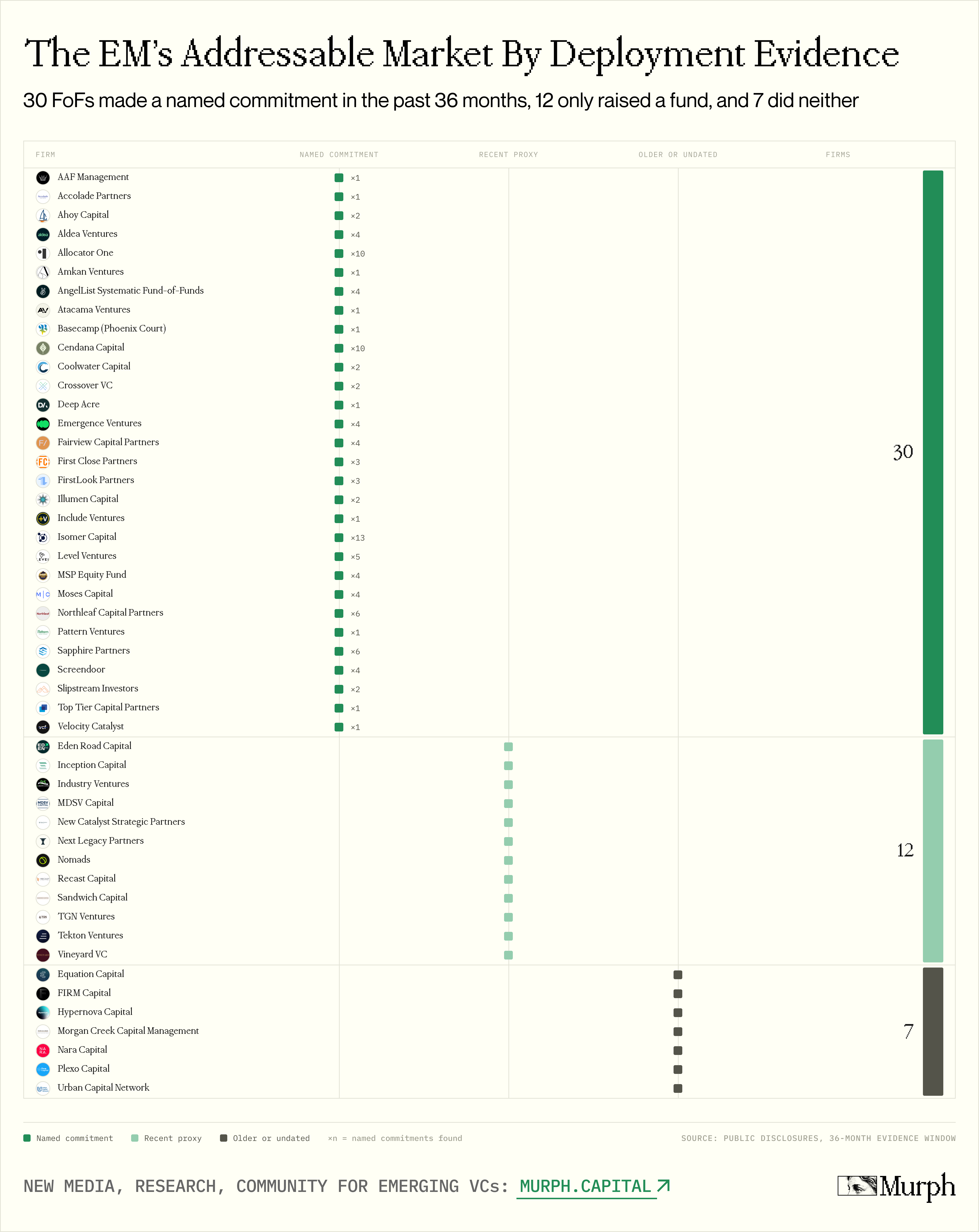
30 of the 49 FoFs have at least one named commitment in the window, 104 in total. The rest split between 12 with only a recent fundraise of their own and 7 with no dated evidence at all.
Activity is concentrated. Isomer (13), Allocator One (10) and Cendana (10) account for 33 of the 104 named commitments, almost a third. Half of the 30 active firms have 2 or fewer, and 10 have only 1.
Dedicated EM FoFs leave a clearer trail. 21 of the 27 EM-focused FoFs have a named commitment in the window, against only 9 of the 22 hybrids. Hybrids also make up 8 of the 12 recent proxies and 5 of the 7 older or undated firms.
Undated is not the same as inactive. The 7 older or undated firms (Equation, FIRM, Hypernova, Morgan Creek, Nara, Plexo and Urban Capital Network) may well be investing. Some, like FIRM (launched just last year), are simply too new for their commitments to show up in public data yet."
II. Geography of Access
12 of the 49 are headquartered outside the United States. That is the number a map gives you, and it is the least useful geographic fact in this report.
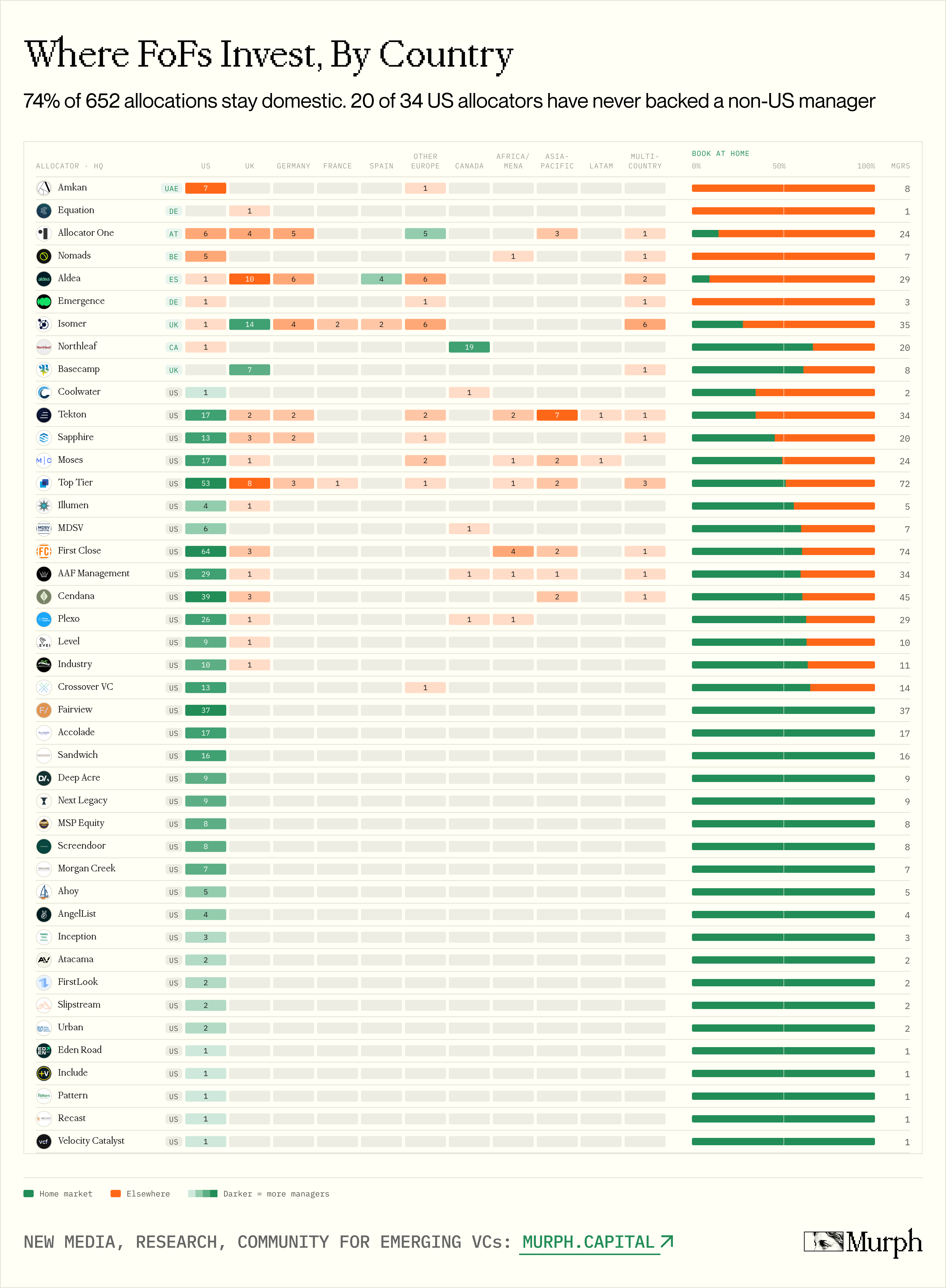
We resolved the headquarters of the underlying manager on 652 allocator/recipient relations for 43 of the 49 firms, out of those 74% of the pairs land in the allocator’s own country. The 6 that are absent have not named a venture manager they back through the firm itself. 4 have named no manager at all. FIRM, like mentioned above, lists only the commitments its partners made before FIRM existed, and New Catalyst names only the private-equity managers it seeds.
A short note on our methodology here:
We collected 652 publicly reproducible named commitments across 43 of the 49 FoFs dataset, no time boundary applies.
Out of those, 361 relationships have explicit commitment wording, rest rely on allocator listing the manager on its portfolio page.
Sources include: allocator and manager websites, fund-close announcements, press coverage, newswire releases, statutory filings and public-institution records, interviews, and partners’ LinkedIn and X posts.
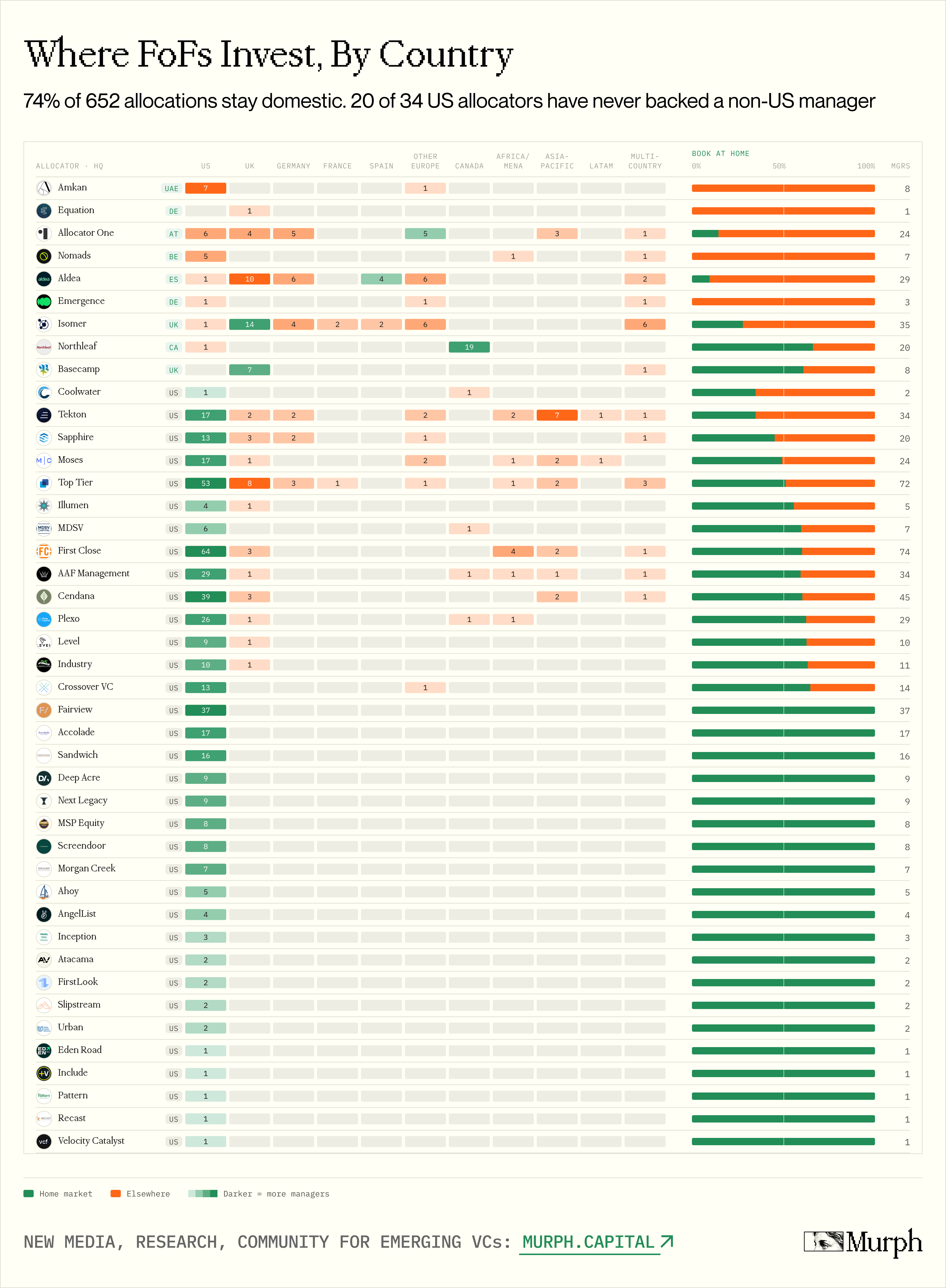
The home bias is almost entirely an American habit.
US allocators are overwhelmingly domestic: 20 of 34 have never named a non-US manager. The median keeps 100% of allocations at home.
Tekton is the outlier: 34 allocations across 12 countries, half of them in the US. Top Tier follows at 74% US.
Non-US allocators show the opposite pattern: the median keeps just 8% of allocations domestically. Only Basecamp and Northleaf are majority-domestic.
Cross-border investing is standard outside the US, but exceptional within it: only 14 of 34 US allocators have done it at all.
Non-US allocators invest into the US more than US allocators invest out:
Allocator One, in Vienna, has 6 of its 24 resolved managers in the US.
Nomads, in Brussels, has 5 of 7.
Amkan, in Dubai, has 7 of 8 and describes itself as a fund of funds for US solo GPs.
And Europe now has 2 developed specialists.
Isomer has named 35 managers. 14 are in the UK, 4 in Germany, 2 each in France and Spain, and 1 each in Czechia, Denmark, Estonia, Finland, the Netherlands, Poland and the US. 6 more publish offices in several countries.
Aldea has named 29. 10 are in the UK, 6 in Germany and 4 in Spain, with 2 each in Estonia and Luxembourg, 1 each in Denmark, Portugal and the US, and 2 in several countries.
Europe’s Missing Allocator Layer
“Europe doesn’t have enough fund managers, particularly not enough young, emerging ones, supporting companies at exactly the stages where the bottleneck is worst [pre-seed to Series A].”
Antler views it as a trap for European startups. Fewer investors are backing European startups at the stages where capital is already hardest to find. In our Part I we described the same issue one level up, where we believe the actual problem stems from: fewer European funds being formed.
If we look at launches, they fell from 576 in 2022 to 167 in 2025. We see them not as 2 separate shortages but as 2 leaks in the same capital cycle:
In a healthy cycle, the funds that backed last cycle's unicorns grow larger, a new generation of emerging managers forms beneath them to fund the next cohort, and angels made liquid by exits take the earliest bets. In Europe the middle layer is not replenishing.
Capital pools are fragmented, pensions largely stay out, governments fill part of the gap, and exits often move value abroad before a deep domestic LP base can form. A thin LP base makes new funds harder to raise. Fewer new funds leave companies with fewer investors, and weaker exits leave less capital and fewer experienced operators for the next generation.
Antler observes the consequence downstream. This report looks upstream, at the institutions meant to fund the managers who are supposed to close that gap. To size that layer, we counted the European managers each of the 49 FoFs has publicly backed.
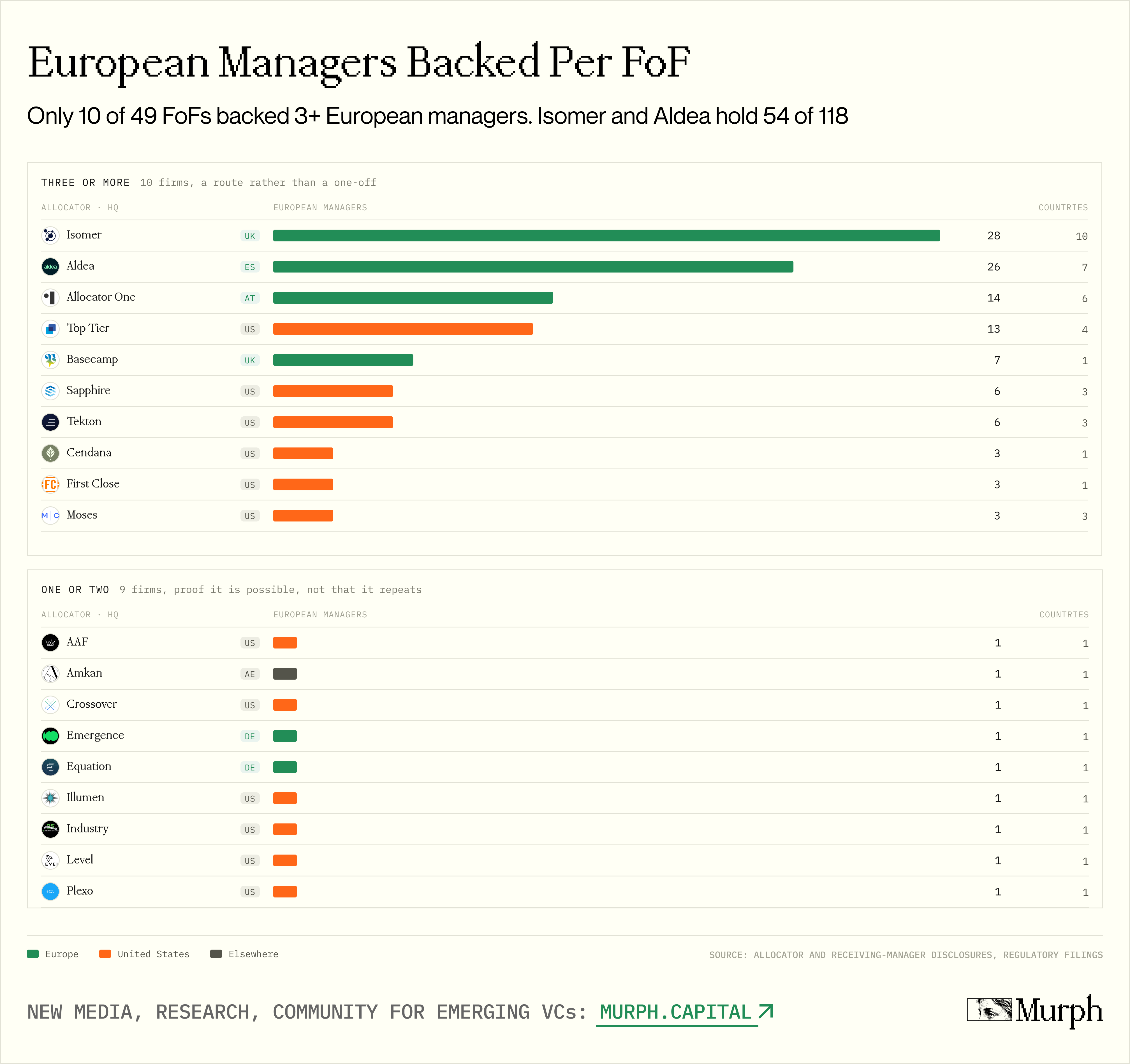
The layer is thin:
Only 10 of 49 allocators have backed 3 or more European managers, and 4 of those 10 are European.
30 of 49 have never named a European manager at all, leaving emerging managers to raise into a narrow, geographically concentrated LP market.
Access Is a Cliff
The same drop-off holds for every EM outside the US and the UK. For each country, we counted how many of the 43 disclosing FoFs have backed at least one manager based there.
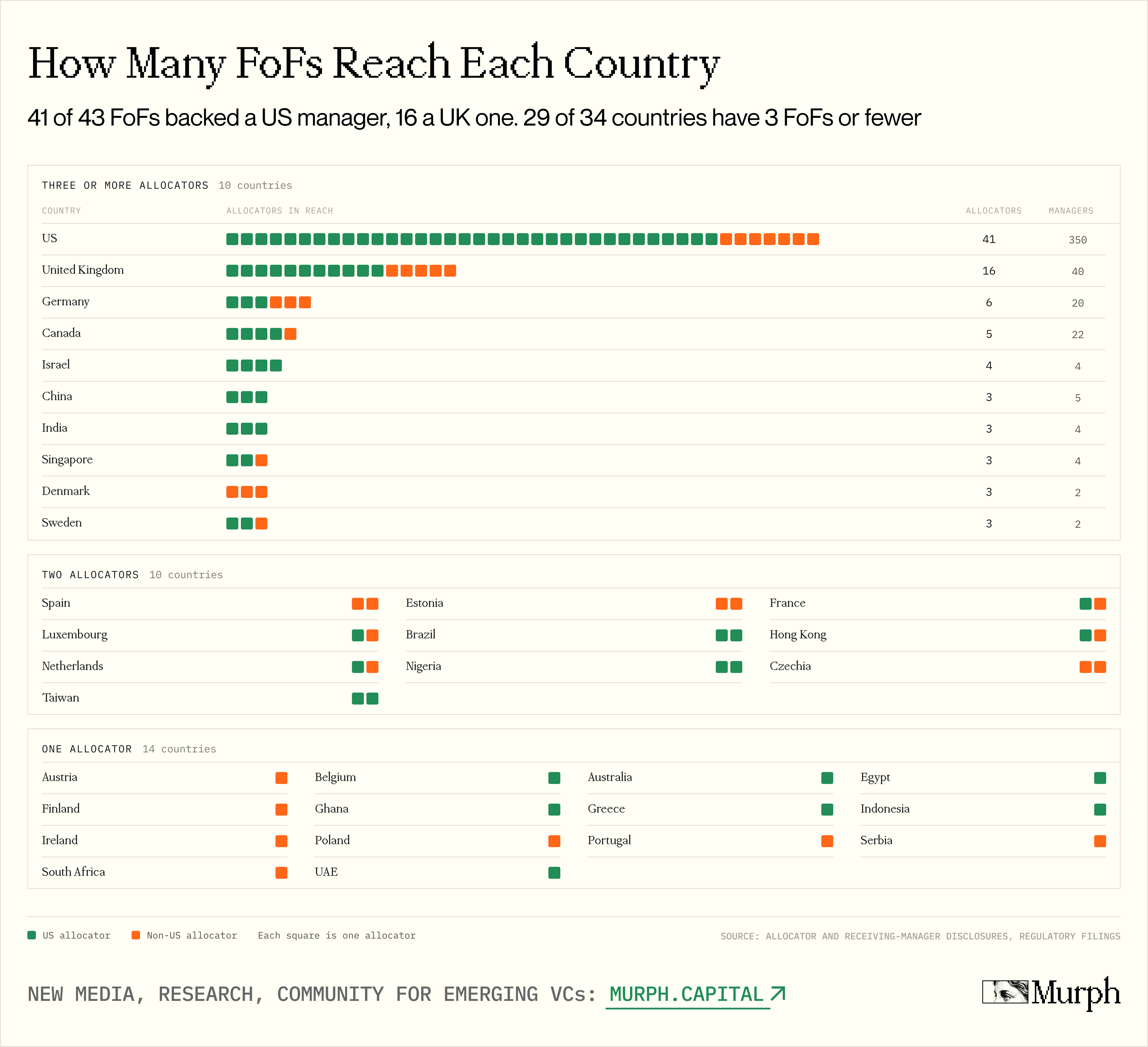
Only 5 countries are reached by more than 3 FoFs, and even among them depth drops fast.
The US is reached by almost everyone. 41 of the 43 FoFs have backed a US manager, 350 managers in total.
The UK is a distant second. 16 FoFs have backed a UK manager, 11 of them American, and they have backed 40 managers between them.
Germany, Canada and Israel each have a handful. Germany is reached by 6 FoFs, split evenly between US and non-US allocators. Canada is reached by 5, but 19 of its 22 managers come through just 1 FoF, Toronto-based Northleaf. All 4 FoFs that reach Israel are American, and they have backed 4 managers between them.
Who reaches the long tail depends on the region. Denmark, Spain, Estonia and Czechia are reached only by non-US FoFs. China, India, Brazil, Nigeria and Taiwan are reached only by American ones.
After that it falls off a cliff: 29 of the 34 countries are reachable from 2 allocators or fewer, and 14 of them from exactly one.
If we restrict the data to pairs where an LP or fund capital commitment is confirmed (such as commitment announcements, rather than an allocator’s portfolio page), the map gets smaller but keeps its shape.
361 of the 652 relations survive, across 38 of the 43 allocators
The manager base falls from 509 managers in 34 countries to 293 in 21
The domestic share holds at 75%, against 74% in the full set.
So why does the map fall off so fast? Distance is rarely crossed alone. Venture syndication assumes that investors reach distant companies through someone they already invest alongside. If allocators work the same way, the cliff is less a verdict on German or Brazilian managers than a map of who knows whom. A country reachable from exactly one allocator is probably reachable through 1 partner's network, not a strategy. For a manager outside the US, the better question may be whose network already reaches them.
Importantly, syndication does not mean that managers far from the hubs are completely out. Buy Local? is a nice reading on this topic. It finds that when investors in the big hubs did go far from home, those deals tended to do well. It looks at the time window of 1975 - 2005, long before the ZIRP era and Zoom-first diligence, so it would be interesting to see how much of this still holds today. Both papers are built around company investing, so their conclusions cannot be fully extended to the FoF discussion. We therefore treat them as an analogy rather than an indisputable fact.
Part of this does carry over, because LPs face the same geography one level up. They tend to lean toward managers close to home, and do better with them. Networks are simply stronger locally, and better-connected investors tend to perform better (hello again, syndication). So it's no surprise that three in four pairs in our data stay domestic.
3 Phases, 3 Products
Part I dated the market by founding year. We decided that for Part II the most representative date for the emerging managers would be the date when the dedicated EM program launched inside those funds. For 9 of the 49 funds those are different years, and at several of them they are decades apart.
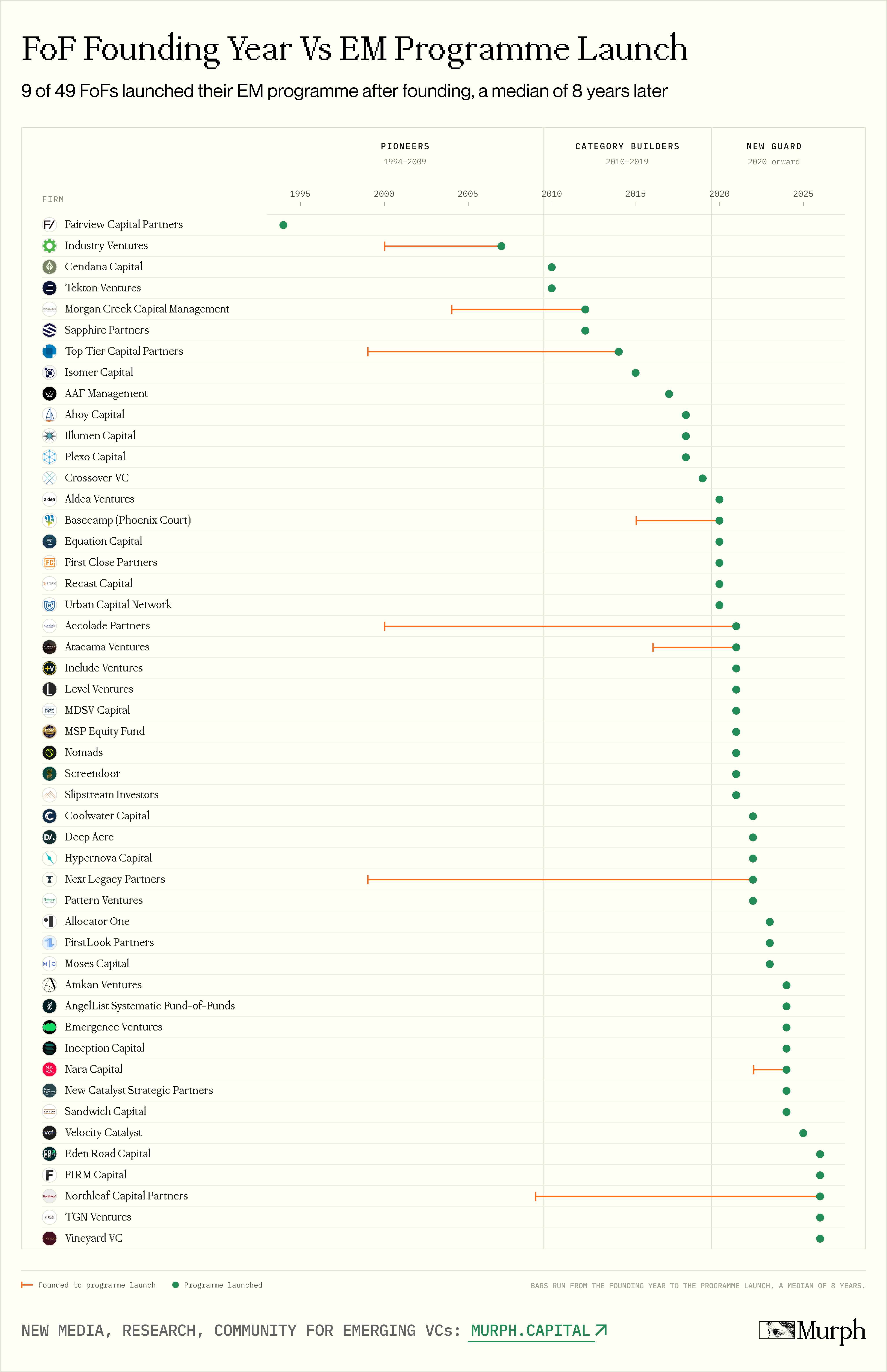
The median gap between founding and programme launch is 8 years.
Next Legacy‘s lineage runs back to 1999, and it launched Emerging Leaders in 2022.
Accolade was founded in 2000 and added Empowerment in 2021.
Northleaf had been running venture funds for 17 years when it launched Discovery in 2026.
The same gap shows up at Top Tier (1999, then 2014), Morgan Creek (2004, then 2012) and Industry Ventures (2000, then 2007).
A programme launch is not the first time these firms touched EMs. Many backed them earlier through other funds. Accolade, for example, invested in EMs from time to time before Empowerment, but the launch made EM backing part of the thesis.
If we were to take the same approach as in Part I, the generations would be too distorted by the delay between fund emergence and program launch. Assuming a median gap of 8 years, the results would be heavily skewed. Re-dated by programme launch, 7 FoFs move into a later generation.
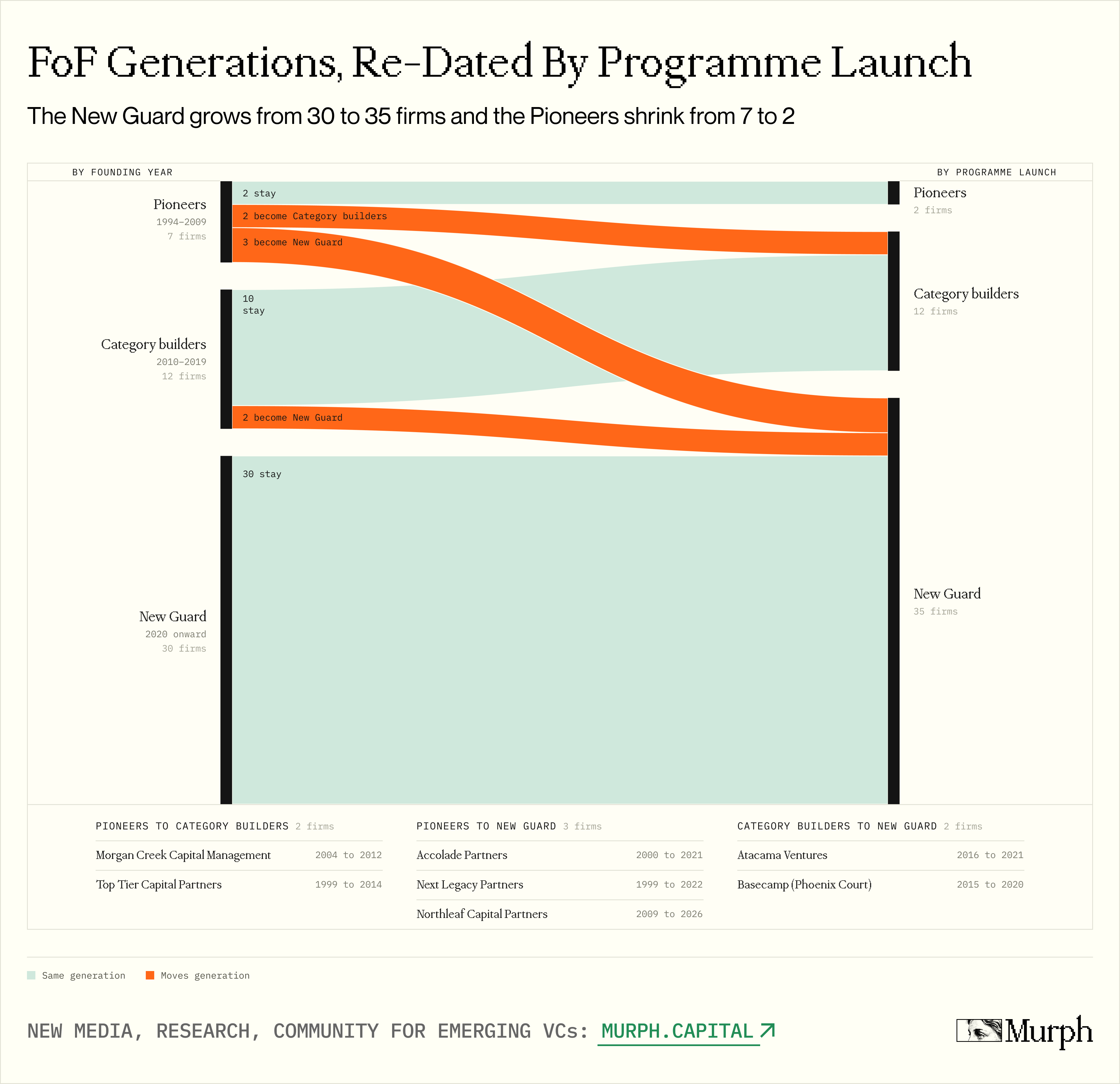
The New Guard grows from 30 to 35 firms, and the Pioneers shrink from 7 to 2. 5 firms founded before 2010 only launched their programmes as Category builders or New Guard. So we split the market into 3 phases to better assess how FoFs evolved in their relations with EMs.
Pioneers (1994 - 2009). 2 firms qualify on the programme dating, Fairview from 1994 and Industry Ventures from 2007, and both were backing new managers before the term “emerging manager” existed in institutional LPs’ vocabulary. The New York State Common Retirement Fund books its Fairview vehicles under Fund of Funds (Captive), which its 2020 asset listing defines as “discretionary accounts that allow CRF to access smaller and specialized private equity funds.”
Category builders (2010 - 2019). 12 FoFs turned EM backing into a thesis. Cendana was among the first, in 2010.
“Michael [Kim] shares how he started Cendana around his thesis (at the time very early) of backing small, emerging managers. This led to early investments in firms such as IA Ventures, Forerunner, and Lerer Hippeau.”
Isomer followed in 2015, Ahoy and Plexo in 2018. Backing a new manager stops being a discovery and becomes an argument.
New Guard (2020 onward). 35 FoFs, most of them about as young as the managers they back. For them EMs look more like startup founders who need more than a cash. The transition was best described by Jason Howard of New Catalyst:
“I’ve seen firsthand that LP capital alone is often insufficient to help Next Generation GPs realize their potential.”
Jason Howard Launches New Catalyst Strategic Partners (2024)
Discover, argue, build. That is what the 3 periods are about. Products are run by people. The next question is who actually decides.
III. People Behind Allocation
The Medici Bank was not a bank as we think of one now. Borrow from a bank today and the bank decides whether to lend to you or not. The Medici ran on personal relations.
The branches across Europe were never a unified institution. They were run by separate people. Thus, the Bruges branch was ran by a partner in Bruges with him being a bank. He put in his own money, he took a share of the profit instead of a salary, and his authority was written down and bounded.
So a merchant approaching the Medici in Bruges was not dealing with the institution. He was dealing with Angelo Tani, and after 1465 with Tommaso Portinari. His chances hinged on how well he knew one of them.
Would you be surprised if we told you that it is pretty much how modern-day FoFs work? The institution is usually not the one deciding, and neither is the fund. 1 or 2 people usually make the final decision, and an EM’s chances depend on knowing which 2 and how to approach them.
Teams, Teams, Teams
For exactly this reason, we mapped 211 people across the 49 FoFs who sit on the investment team (excluding external advisors and venture partners) and may influence the investing process. The goal is to test 2 premises: (1) what backgrounds this market runs on and (2) who decides a commitment. The broader cut covers the whole investment team inside each fund, so it answers the first premise.
The core backgrounds we identify are assigned by the following criteria:
Founder or operator. Founded or ran an operating business: founder, CEO, COO, CTO, president, GM, or head of product/engineering/growth/sales
Former GP or VC. An investment team role at a venture or growth-equity firm; a manager investing directly into companies out of its own fund
Institutional LP. Invested other people’s money into funds, or advised someone who did: endowments, foundations, pensions, sovereign wealth, insurance, family offices, OCIOs, consultants, other fund-of-funds
Ecosystem builder. Ran or staffed an accelerator, incubator, fellowship, industry association or economic-development body serving this asset class
PE or high finance. An investing seat in investment banking, M&A and transaction advisory, capital markets, equity research, trading, lending, and portfolio valuation for alternatives.
Mission led. A seat whose explicit purpose was impact, diversity, underrepresented founders or managers, or a mission mandate.
2 further groups stand out:
One is Advisors or specialists, which absorbs unconventional paths into VC: lawyers, accountants, civil engineers and so on.
The other is Early career, usually junior roles whose only background before the current firm was university or internships.
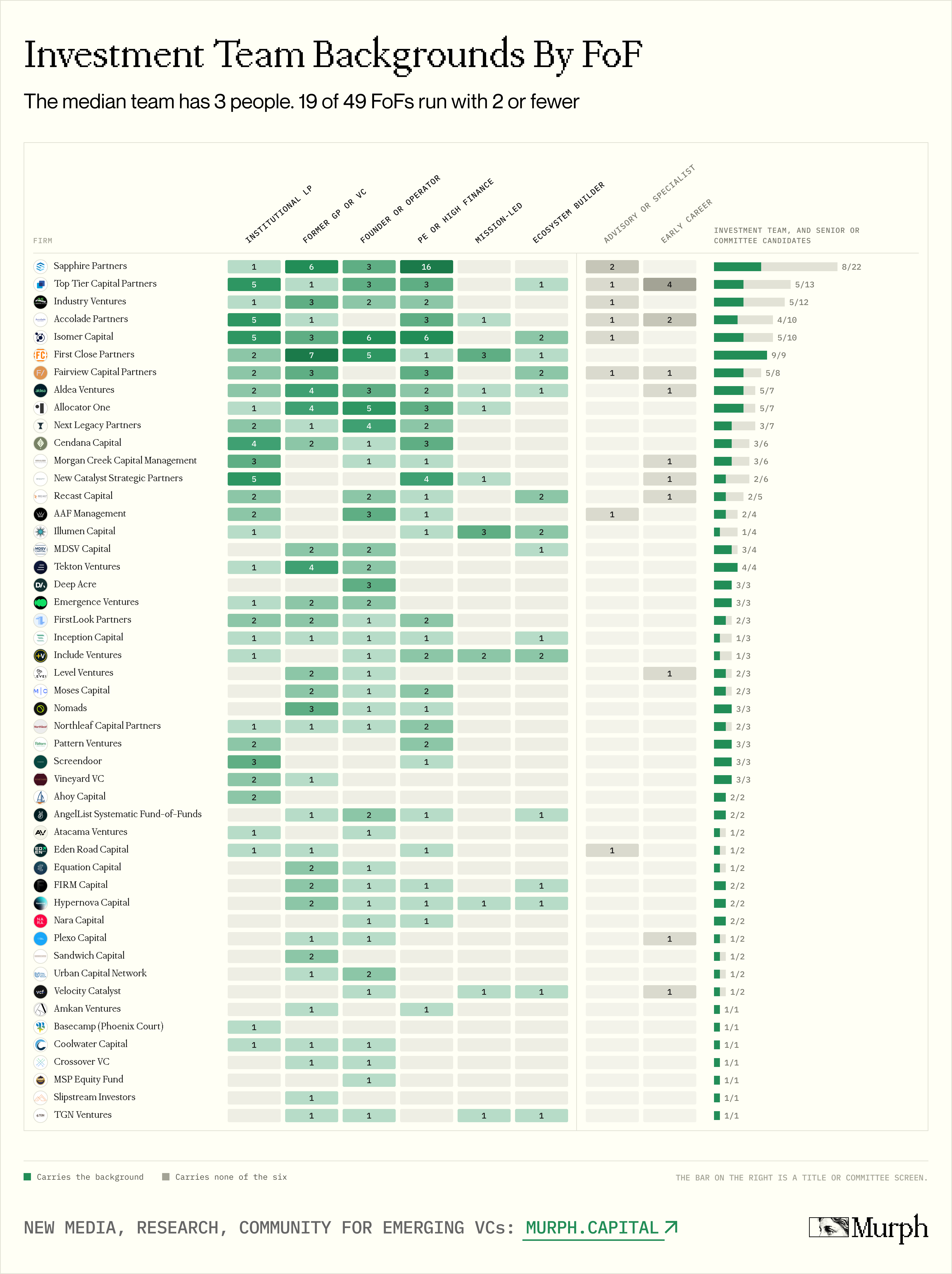
3 things stand out.
Teams are small. The median FoF has 3 people on its investment team. 19 of the 49 run with 2 or fewer, and 7 with 1 person.
Headcount is concentrated. The 3 largest teams, Sapphire (22), Top Tier (13) and Industry Ventures (12), hold 47 of the 211 people, 22% of the total.
1 fund tilts the finance count. 16 of the 71 people with a PE or high-finance background sit at Sapphire. Without it, that background drops from 34% to 29% of everyone else.
Sapphire Partners, the fund investing arm of Sapphire Ventures, leads a count with 22 people recorded. However, it might be a bit misleading. In April 2026 the whole team behind this fund-investing arm of Sapphire Ventures, led by Beezer Clarkson, moved to LGT Capital Partners.
Sapphire still manages more than $2bn in fund investments, with that same team supporting it from LGT. No one inside Sapphire has been named to the strategy since. So we show Sapphire Ventures' own investment team of 22 people as they still name themselves an active deployer.
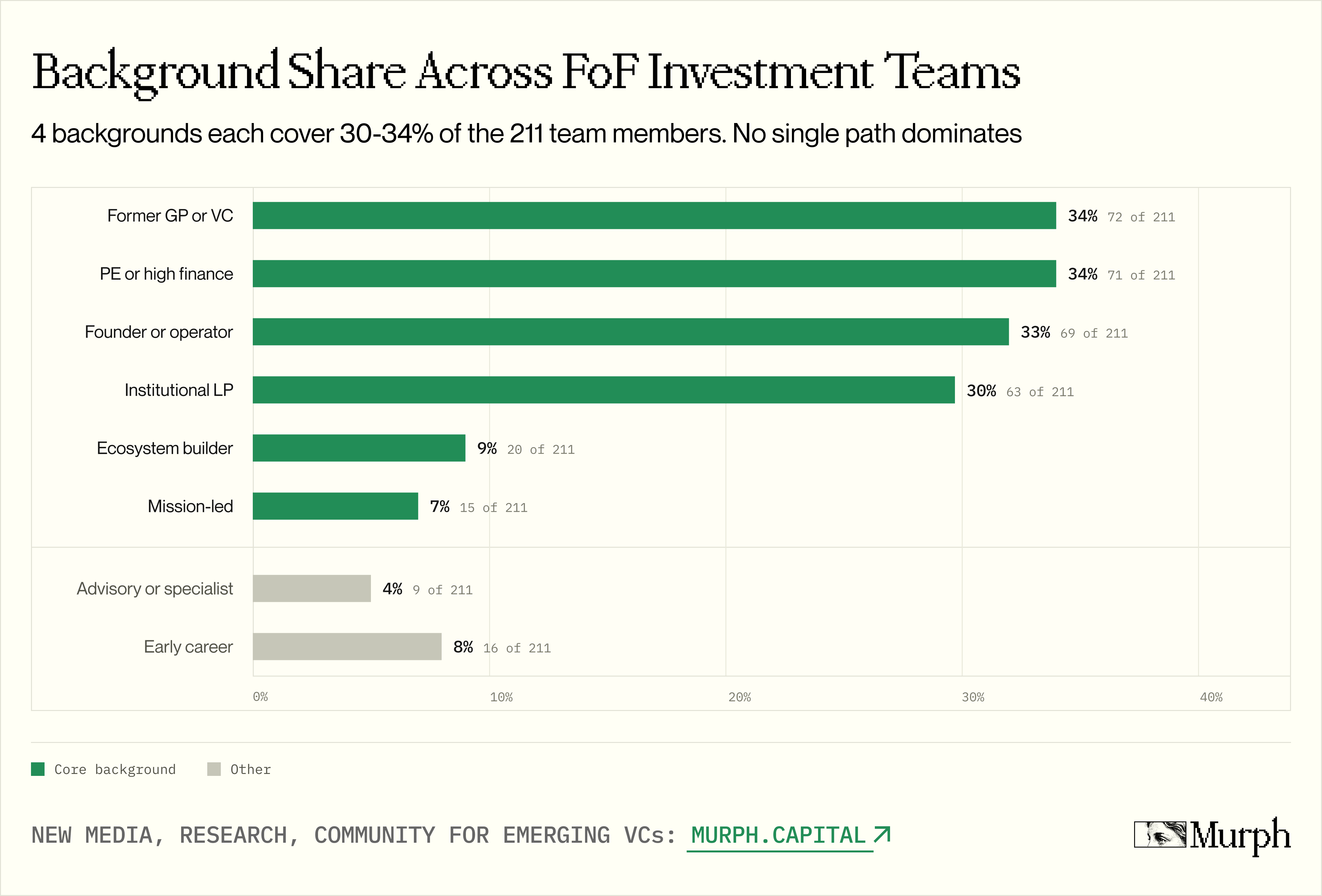
Surprisingly or not, we cannot name a dominating group. The top 4 backgrounds differ only marginally, Former GP or VC (72), PE or high finance (71), founder or operator (69) and institutional LP (63) are only 9 people apart. This is, to be frank, inside the margin of any one judgement call, so we view them as 4 backgrounds of roughly equal weight rather than as a ranking.
Ex-investors include Cendana‘s Michael Kim, Slipstream‘s Alex Edelson, a venture partner at Zeno Capital before he ran operations at QED, Isomer‘s Chris Wade, Tekton‘s Vincent Worms, a managing partner at Partech International for 30 years, and Industry‘s Roland Reynolds, a principal at the venture firm Columbia Capital and then managing partner of Little Hawk Capital Management before he joined Industry in 2009.
Institutional allocators include Ahoy‘s Chris Douvos from Princeton’s endowment and TIFF, Morgan Creek‘s Daniel Kingston from the Kauffman Foundation’s investment office, Northleaf‘s Ian Carew from CalPERS and Ontario Teachers’, New Catalyst‘s Jason Howard from GCM Grosvenor, Eden Road‘s Lindel Eakman from UTIMCO, and Isomer‘s Astrid Noltemy, who came to it from research roles at Charles River Ventures and Highland Capital and a managing directorship at Cambridge Associates.
Operators are people like Deep Acre‘s Alexander Keith, who spent a decade building a private-label supply-chain business, and Allocator One‘s Michael Strock, who founded KochAbo and ran it as chief executive.
The background says what the career was, but we were also interested in the door somebody walked through to get here. So, is there a pipeline into EM-focused FoFs?
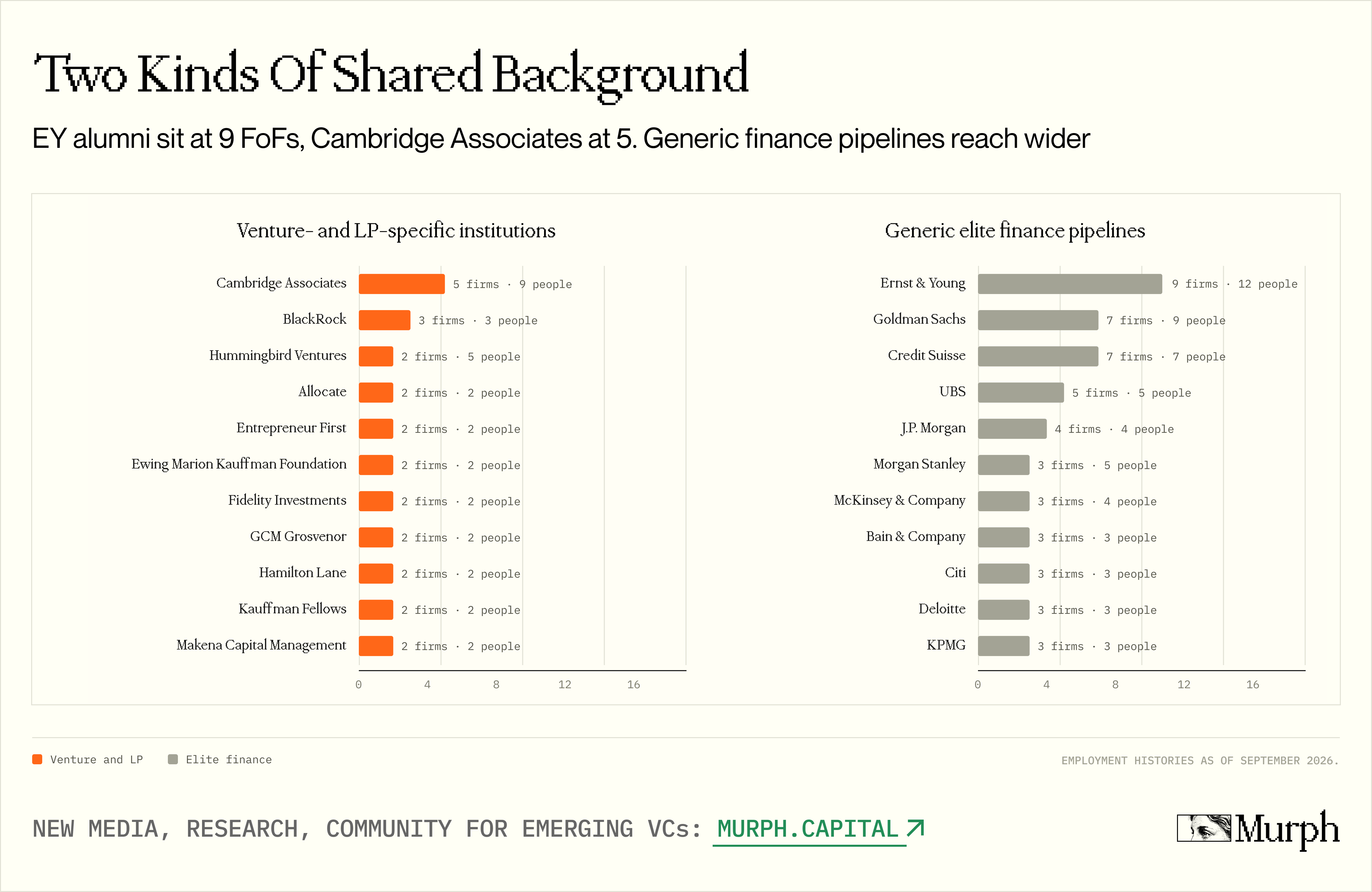
Well, not really. Cambridge Associates stands out, with 9 people across 5 funds who came out of it, 3 of them at Isomer alone: Joe Schorge, Michael Joyce and Astrid Noltemy. It is the exception rather than the rule. As for the general finance pipeline, it is not really a finding. People expect folks from Goldman Sachs and JP Morgan to pop up here and there, right?
Decision Makers
A large team is not a wide door for an emerging manager, though. Headcount inflates the investment team at the large firms, but the interesting finding is that the number of decision makers grows far slower: the 3 biggest teams, Sapphire with 22 people, Top Tier with 13 and Industry Ventures with 12, have 8, 5 and 5 senior seats, against a median of 2 across all 49.
If breadth follows headcount, then so might the ranking. A share of people is weighted by team size, thus a background may dominate among funds simply because those that staff up share it. So we got curious whether the proportions would change if we removed the non-decision makers from the dataset and kept only senior titles and named committee seats. That is how we answer the second premise.
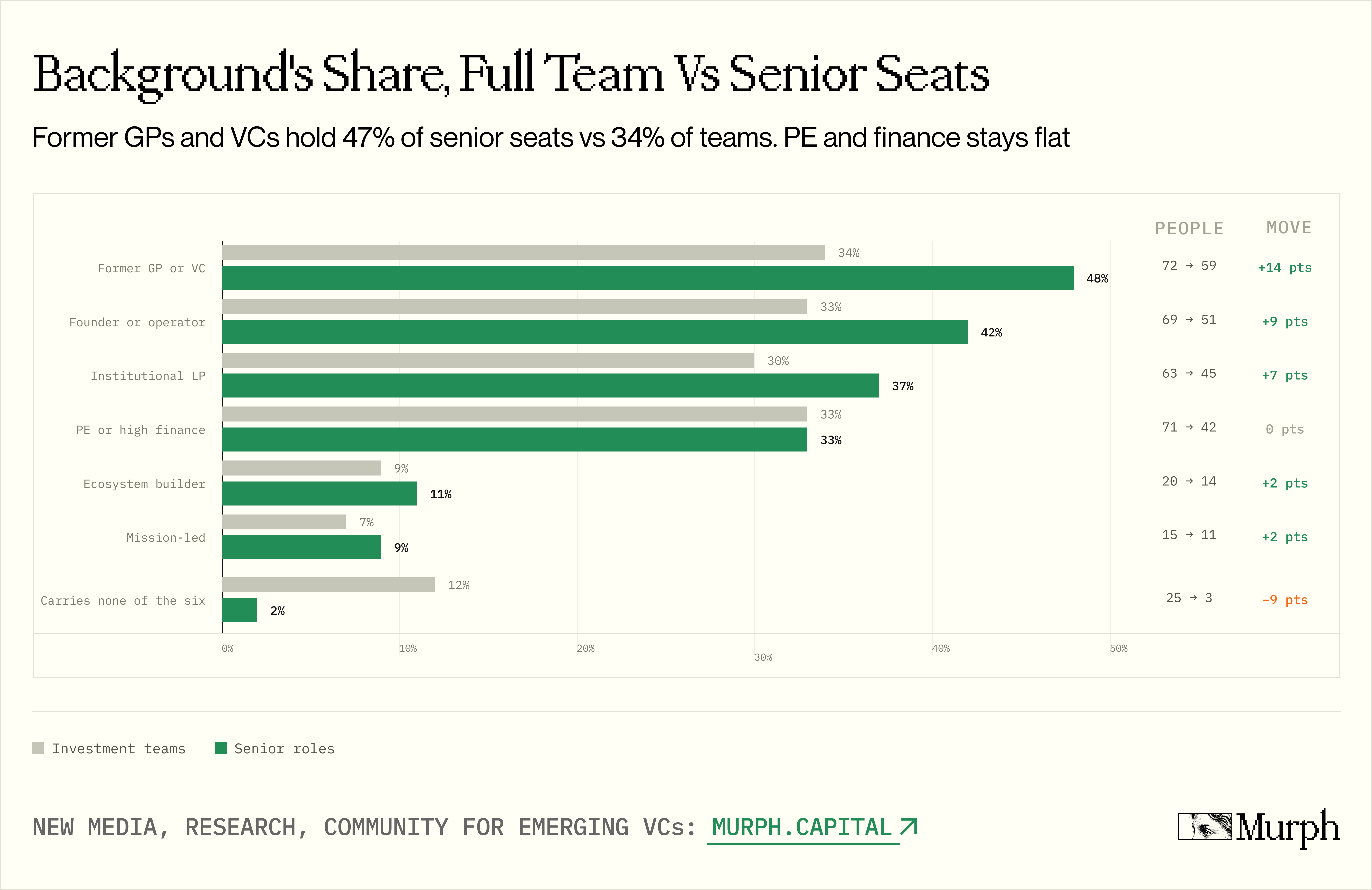
We spotted 4 main changes between the wider team and the decision-makers cut:
The order changes. Across the full teams, the 4 leading backgrounds sit within 9 people of each other, close enough that calling any of them the market’s dominant background would be a rounding error. Among the senior seats former GP or VC pulls clear at 48%, ahead of founder or operator at 42%.
3 main backgrounds rise. Former GP or VC (+14 points), founder or operator (+9) and institutional LP (+7) all gain share among the senior seats.
1 background barely moves. PE or high finance is 34% of investment teams and 33% of the senior seats, the only one of the 4 large backgrounds that does not gain share.
And the blank collapses. The fraction of the team from early career and advisory backgrounds fall from 25 of 211 (12%) to 3 of 126 (2%).
Let’s get a bit philosophical here. One distinction never left our heads while we worked on this part, real versus formal authority. When the dataset is built from open sources you inevitably mix the two. A senior seat grants formal authority, but it does not always extend into real authority. We see real authority as something that extends far beyond voting rights on the IC. Think about this as partner’s ability to be out there, shape opinions, pull people into a deal, and move before a formal decision. Unfortunately, that is usually invisible in public sources, but we can track how those backgrounds translate into what a decision maker asks for.
What Background Changes in the Room
We asked ourselves what knowing someone’s background actually gives an EM beyond a couple of extra lines in the call-prep notes. We think the answer is that it tells you what they want to hear from an emerging manager. There are 4 answers we expected to hear:
Institutional allocators demand portfolio construction and governance;
Former GPs probe sourcing and reserves;
Operators care about network and founder access;
Mission-led investors need both return logic and mandate fit
So, to test some data against those assumptions we collected 651 public statements from 48 FoFs about what they look for in emerging managers from sources including podcasts, interviews, SEC filings, and posts. Then, for each background we compared how often FoFs led mostly by that background raise a topic against all other funds, in percentage points.
Important note: this is descriptive and limited to what funds say in public and, frankly, what we were able to find. Logically, funds that publish more mention more topics, thus skewing the data. To correct for that, we gave every fund the same weight by drawing 5 of its statements at random, 2,000 times over, and averaging the results. The fact that most FoFs have several backgrounds inside doesn't make it any easier or more credible either. Read it as something to think with rather than proof.
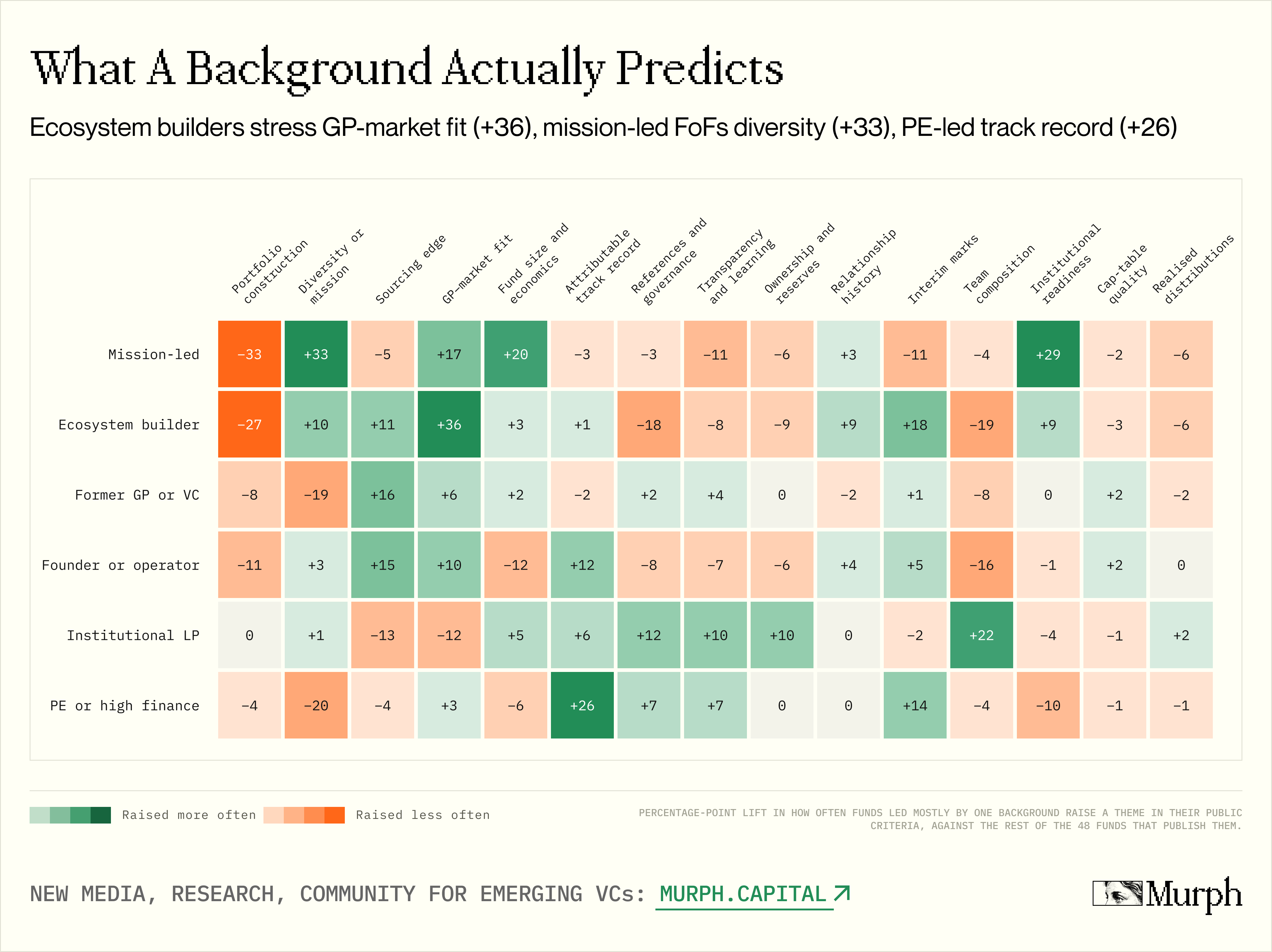
Were our expectations right? Partially yes, partially data tells different story:
LP-led FoFs care most about the team. They bring up team composition far more than anyone else (+23), and governance and references more often too (+13). Portfolio construction, which we expected from them, barely registers (−1).
Former GPs do talk about sourcing. It’s their standout topic (+16), but reserves don’t come up any more than elsewhere.
Operators care about access. Sourcing and founder access come up more often in operator-led FoFs than anywhere else (+15).
Mission-led FoFs lead with the mandate. Mandate fit is the strongest signal in the whole chart (+33), while track record sits right at the average.
Finance-led FoFs were the surprise. We had no guess for them, yet they bring up track record (+25) and interim marks (+15) more than any other group.
Track record comes up in almost every conversation, and most of all with finance-led FoFs. What counts as one is less clear.
Helen Min, in Dan Gray’s August 2026 interview, sits on the GP side here:
“I think I had 30 companies as an angel investor before I started a fund. I was told many times, oh, we don’t really view that as track record. And I have to say, I agree. It is quite different to be writing small checks of your own … versus thinking about how you’re managing outside capital.”
Helen Min, From Facebook’s Early Days to a Solo $10M Pre-Seed Fund (2026)
That is one manager’s experience, yet it points at the gap. Portfolio construction, reporting, reserves and governance are not visible in an angel list, nor are many of the other things FoFs look for. Thus, the track record is often not enough. Remember our MacMahon’s analogy? Matrix we assembled gives us a nice basis for speculation about what people with differing backgrounds might appreciate or focus on more.
The Players Wall
When reaching out to the Medici bank, a merchant in Bruges at least knew which door to knock on. In venture, emerging managers rarely get that luxury – so we end this section by putting a face and a name on every door.
Below is the complete roster of decision-makers actively backing the next generation of funds. You’ll find all 49 allocators from our dataset here, along with Murph Capital as we’ve recently started backing select fund managers within our own close network.
Key Takeaways
Only a third of the universe is built for EMs. 49 of the 146 funds make primary commitments to venture funds and treat emerging managers as their main product. 27 are dedicated EM FoFs and 22 are hybrids.
Fund-only allocators are rare. 38 of the 49 also invest directly or co-invest. Only 11, all of them specialists, back funds and nothing else.
The LP most likely to back an EM’s Fund I is about as young as the fund itself. 30 of the 49 were founded in 2020 or later, and 28 of those 30 are specialists.
Fewer than two thirds show a named commitment. 30 of the 49 named at least one in the last 36 months. Isomer, Allocator One and Cendana account for 33 of the 104, and 7 FoFs show no dated evidence at all.
Home bias is an American habit. 74% of named relationships stay in the allocator’s home country. 20 of 34 US allocators have never named a non-US manager, while non-US allocators keep a median of just 8% at home.
Access falls off a cliff after the US and UK. 41 of the 43 disclosing allocators have backed a US manager and 16 a UK one. Next come Germany with 6, Canada with 5 and Israel with 4, and 29 of the 34 countries are reached by 3 FoFs or fewer.
Europe has an allocator gap. Only 10 of the 49 have backed 3 or more European managers, and only 4 of those 10 are European. 30 of the 49 have never named a European manager.
EM programmes are younger than the firms that run them. 9 FoFs launched their EM programme a median of 8 years after founding. Dated by programme launch, 35 of the 49 belong to the New Guard.
Teams are small and decisions are concentrated. The median FoF has 3 people on its investment team and 2 senior seats. 19 of the 49 run with 2 people or fewer.
Former GPs dominate the senior seats. Across all 211 people, 4 backgrounds sit within 9 people of each other. Among the 126 senior seats, former GPs pull clear at 48%.
Resuspended
MacMahon wasn't rejected in 1889, he was resuspended, which meant good enough but with no room yet. He was held back by the same kind of factors today's emerging managers face but rarely get to see.
Well, a list of funds of funds is easy to find. A list of the ones that are deploying, reach an EM's market and have someone who can say yes is another story. That is the list this part tried to build.
A few questions still need answers before that list is complete.
What LPs back these FoFs, and what does their money expect in return?
Who have they backed before, and at what fund number and fund size?
How early do they go? Do they commit at pre-seed, or wait until a manager moves up a stage?
Who comes back for Fund II, and who actually receives the money?
Which partners speak in public, and what do they say about emerging managers?
So Part III feels inevitable, and in it we go one level deeper again. Subscribe and stay tuned.
Great data and insights! “The LP most likely to back an EM’s Fund I is about as young as the fund itself. 30 of the 49 were founded in 2020 or later, and 28 of those 30 are specialists.”
Great post ! Thanks again Murph Team 👀